Toyota V8 Engines – Models, Specs, Reliability & Used Engines
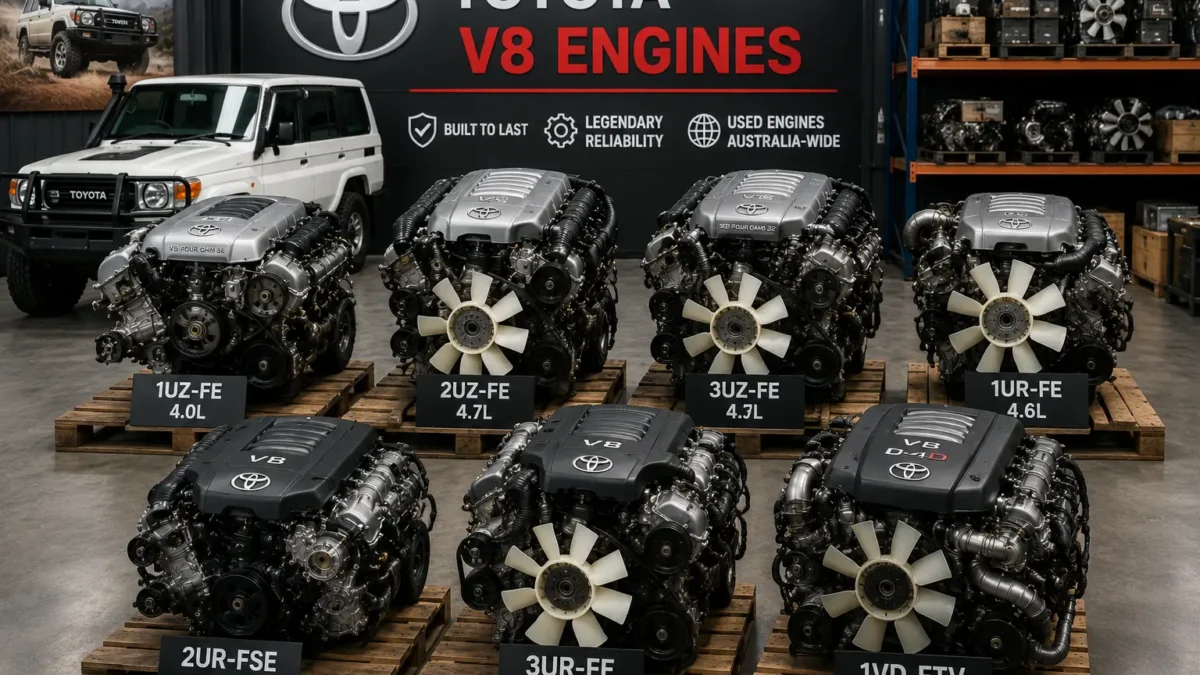
Table of Contents
- Toyota V8 Engines at a Glance
- Toyota V8 Engine Families Explained
- Toyota LandCruiser V8 Engines
- Toyota Crown V8 Engines
- Toyota Soarer V8 Engines
- Other Toyota V8 Applications
- Which Toyota V8 Engine Do I Need?
- Are Toyota V8 Engines Reliable?
- Common Toyota V8 Engine Problems
- Is the Toyota 4.6 V8 a Good Engine?
- Toyota LandCruiser V8 Engine Oil Capacity
- Used Toyota V8 Engines for Sale
- What to Check Before Buying a Used Toyota V8 Engine
- Toyota V8 Supercars & Supra Engine
- 6. Engine Comparison Table
- What V8 engines did Toyota make?
- Does Toyota make a V8 engine?
- Which V8 engine is in a Toyota LandCruiser?
- Is the Toyota 4.6 V8 a good engine?
- What is the Toyota LandCruiser V8 engine oil capacity?
- Which Toyota models came with V8 engines?
- How do I identify my Toyota V8 engine?
- Can I buy a used Toyota V8 engine?
- What V8 engine does the Toyota Supra Supercar use?
Toyota has fitted V8 engines across several completely different platforms since 1989, and “Toyota V8 engine” on its own isn’t enough to identify which one you’re looking at. There are petrol V8s (the UZ and UR families) and a purpose-built diesel V8 (the 1VD-FTV), spread across LandCruisers, Crowns, Soarers and a handful of Lexus-badged siblings. In Australia, the LandCruiser is the V8 application most people are searching for — but even within LandCruiser, the correct engine depends on the series, the year, and whether you’re running petrol or diesel. This page breaks down each Toyota V8 family, where it was actually used, and what to confirm before ordering a replacement or used engine.
Toyota V8 Engines at a Glance
| Engine Family/Code | Displacement | Fuel | Aspiration | Configuration | Common Toyota Applications | Approx. Production Period |
| 1UZ-FE | 4.0L (3,969cc) | Petrol | Naturally aspirated | V8, DOHC 32-valve | Soarer (Z30), Crown Majesta | 1989–2002 |
| 2UZ-FE | 4.7L (4,663cc) | Petrol | Naturally aspirated | V8, DOHC 32-valve | LandCruiser 100/105 Series | 1998–2011 |
| 3UZ-FE | 4.3L (4,292cc) | Petrol | Naturally aspirated | V8, DOHC 32-valve | Crown Majesta, Soarer (Z40) | 2000–2013 |
| 1UR family (1UR-FE/FSE) | 4.6L (4,608cc) | Petrol | Naturally aspirated | V8, DOHC 32-valve | LandCruiser 200 Series (select markets) | 2006–2021 |
| 2UR family (2UR-FSE/GSE) | 5.0L (4,969cc) | Petrol | Naturally aspirated | V8, DOHC 32-valve | Lexus F performance models; base architecture for the 2026 Supercars GR Supra V8 | 2007–2026 |
| 3UR family (3UR-FE/FBE) | 5.7L (5,663cc) | Petrol | Naturally aspirated | V8, DOHC 32-valve | LandCruiser 200 Series (select markets) | 2007–2021 |
| 1VD-FTV | 4.5L (4,461cc) | Diesel | Twin-turbo (200 Series); single-turbo (70 Series) | V8, DOHC 32-valve | LandCruiser 200 Series; LandCruiser 70 Series (Australia, until 2024/25) | 2007–2024/25 (Australia) |
Toyota badged variants of these engines differently across Lexus, JDM Toyota and export-market vehicles, and individual variants within a family — FE versus FSE versus GSE, single-turbo versus twin-turbo — aren’t automatically interchangeable. Exact fitment always depends on the specific model, market and production year. Confirm using your engine code and VIN rather than the family name alone. (Where individual engine-code pages exist on this site, they should be linked directly from this table.)
Toyota V8 Engine Families Explained
The UZ family — 1UZ-FE, 2UZ-FE, 3UZ-FE (1989–2013) Toyota’s first V8 family, launched alongside the original Lexus LS400 in 1989. Quad-cam, 32-valve DOHC petrol engines throughout. The 4.0L 1UZ-FE was built for smoothness and refinement in luxury applications. The 4.7L 2UZ-FE switched to a cast-iron block and was tuned for low-end torque rather than outright refinement — this is the version that ended up in the LandCruiser 100 Series. The 4.3L 3UZ-FE effectively replaced the 1UZ-FE in later luxury models. For a replacement-engine buyer, the practical point is that these three share a family name and not much else — a 2UZ-FE out of a LandCruiser and a 3UZ-FE out of a Crown Majesta aren’t a straight swap for each other.
The UR family — 1UR, 2UR, 3UR (2006–present) Toyota’s replacement for the UZ series, all-aluminium construction throughout, still DOHC 32-valve. The 4.6L 1UR-FE/FSE went into the LandCruiser 200 Series in some markets, replacing the 2UZ-FE. The 5.7L 3UR-FE (and E85-capable 3UR-FBE) is the largest-displacement version, fitted to the LandCruiser 200 Series, Tundra and Sequoia. The 5.0L 2UR-FSE/GSE sits apart from the other two — it’s a Lexus F-series performance engine (IS F, RC F, GS F, LC 500) rather than a LandCruiser engine, and it’s the architecture Toyota adapted for its 2026 Supercars GR Supra V8 (see below).
The 1VD-FTV — Toyota’s V8 diesel (2007–2024/25 in Australia) Toyota’s first V8 diesel, and for most Australian buyers the most commercially relevant engine on this page. A 4.5L twin-turbo common-rail diesel fitted to the LandCruiser 200 Series from 2007, and to the LandCruiser 70 Series (VDJ76/78/79) from 2007 with a single turbo instead of twin. Toyota Australia discontinued the V8 from the 70 Series through 2024–2025, replacing it with a 2.8L four-cylinder turbo-diesel — so within that platform it’s now an engine you’ll find in used and older vehicles rather than something fitted to a new one. For the naturally aspirated straight-six diesel it originally sat alongside in the 70 Series, see [Internal Link: Toyota 1HZ Engine].
Toyota LandCruiser V8 Engines
“Toyota LandCruiser V8 engine” is one of the most commonly searched terms on this topic, and it’s also the phrase most likely to get someone the wrong engine if taken literally. Depending on series, year and market, a LandCruiser V8 could mean:
- The 4.7L 2UZ-FE petrol V8 (100/105 Series, 1998–2007)
- The 4.5L 1VD-FTV twin-turbo diesel V8 (200 Series, 2007–2021; 70 Series, 2007–2024/25)
- The 4.6L 1UR-FE or 5.7L 3UR-FE petrol V8 (200 Series, in markets that received the petrol option)
The current 300 Series LandCruiser (2021–present) doesn’t run a V8 at all — Toyota moved to a twin-turbo V6 (petrol and diesel) for that generation. If you’re chasing a brand-new LandCruiser V8, the honest answer is that Toyota isn’t currently building one. [Internal Link: Toyota LandCruiser Parts]
Because of that spread, ordering a used or replacement LandCruiser V8 off the model name alone is a genuine risk. Before enquiring, have ready: your VIN; model and series (70, 100/105 or 200); year of manufacture; fuel type; the engine code stamped on your current engine, if visible; and any known engine history. Send that through and we can confirm exactly which engine you need and check current availability, rather than guessing from “LandCruiser V8” alone.
Toyota Crown V8 Engines
Most Toyota Crown sedans sold internationally were never fitted with a V8 — the mainstream Crown ran inline-six or V6 petrol engines through most of its history, and the current Crown (sold in some markets from 2022) uses hybrid four-cylinder power. The V8 belongs specifically to the Crown Majesta, a flagship JDM-only variant sold in Japan from 1991 to 2018. Early Majesta models used the 4.0L 1UZ-FE, later switching to the 4.3L 3UZ-FE, and the final generation also offered a 4.6L 1UR-FSE V8 alongside the 3UZ-FE. If you’re chasing a Toyota Crown V8 engine specifically, it’s almost certainly a Crown Majesta unit — confirm the exact chassis code before assuming compatibility with a standard Crown.
Toyota Soarer V8 Engines
The Toyota Soarer V8 refers to the Z30-series Soarer, sold in Japan from 1991 to 2000 and mechanically related to the export Lexus SC400. Soarer V8 grades (UZZ30, UZZ31 and UZZ32 chassis codes) ran the 4.0L 1UZ-FE — the same engine used in the contemporary Lexus LS400. The later Z40-series Soarer (2001–2005), sold alongside the Lexus SC430 internationally, moved to the 4.3L 3UZ-FE. If you’re sourcing a Soarer V8 engine or replacement, the chassis code tells you which of the two generations you’re actually dealing with, since they don’t share the same engine.
Other Toyota V8 Applications
A few other applications are worth knowing for identification purposes, without turning this into an exhaustive list. The 2UZ-FE also appeared in the US-market Toyota Tundra and 4Runner, and the UR-family engines were shared with several Lexus models — the GX, LX, LS and IS F/GS F/RC F among them — because Toyota and Lexus vehicles built on shared platforms commonly used the same base engine family. Sharing a family isn’t the same as being interchangeable: Lexus-spec engines can differ in tune, accessories, engine management and mounting even where the core architecture matches, so a Lexus-sourced engine isn’t automatically a straight swap into the equivalent Toyota model without checking those details. [Internal Link: Toyota Engines]
Which Toyota V8 Engine Do I Need?
“Toyota V8 engine” describes a category, not a single product — on its own, it’s not enough information for anyone to identify a replacement. Working through the same process a parts specialist would use gets you the correct engine faster and avoids paying freight on the wrong one.
- Vehicle model — LandCruiser, Crown, Soarer or another application
- Year of manufacture — specification and tune can change mid-generation
- Series or chassis code — 70, 100/105 or 200 Series for LandCruiser; UZS/GWS for Crown; UZZ3x or Z40 for Soarer
- Petrol or diesel — particularly relevant for LandCruiser, where both existed side by side
- Engine code — stamped on the block, the definitive identifier once you can see it
- VIN — lets a seller cross-check what your specific vehicle left the factory with
- Accessories and specification — even within one engine code, brackets, sensors and ancillaries can differ by market and equipment level
Engines within the same family aren’t automatically identical. A 3UR-FE out of a US-spec Tundra and a 3UR-FE out of a 200 Series LandCruiser share an engine code, but ancillary fitment and minor specification can differ by market — which is exactly why the checks above matter more than the code alone.
To get compatibility and availability confirmed, send through your VIN, Toyota model, year, engine code and postcode and we’ll check what’s genuinely correct for your vehicle. [Internal Link: Used Engine Buying Guide]
Are Toyota V8 Engines Reliable?
Toyota’s V8s have a strong overall reputation, and it’s a reasonably earned one — but “Toyota V8” spans seven engine families across more than three decades, and reliability isn’t one transferable property across all of them. What actually determines how well an individual V8 holds up: the specific family and generation, servicing history (timing belt/chain and water pump intervals included), kilometres and how the vehicle was used, cooling system condition and any overheating history, whether it’s been modified, and any prior repair work.
Broadly, the naturally aspirated petrol V8s — UZ and UR — have a reputation for running well past 300,000–400,000km with routine maintenance, and the 2UZ-FE and 3UR-FE in particular are widely regarded among Toyota’s more durable engines. The 1VD-FTV diesel is strong and torquey, but as a twin-turbo diesel it’s more sensitive to oil quality and change intervals than the naturally aspirated inline-six diesels it replaced — turbo longevity depends heavily on servicing discipline. None of this means every individual engine you find is in good condition; the family is a reasonable starting point, and the specific engine’s own history is what actually matters.
Common Toyota V8 Engine Problems
UZ family (1UZ-FE, 2UZ-FE, 3UZ-FE) These run a timing belt rather than a chain, with a replacement interval commonly cited around 90,000–150,000km depending on application. A failed belt risks contact between valves and pistons, so belt and tensioner condition — and confirmed replacement history — matters more here than on a chain-driven engine. Head gasket wear is sometimes raised in relation to the 2UZ-FE specifically, though long-term owners are genuinely split: some report no issues at very high kilometres, others have replaced gaskets on overheated or very high-kilometre examples. Treat it as worth checking (coolant condition, any overheating history) rather than an assumed fault.
UR family (1UR, 2UR, 3UR) Water pumps on UR-family engines have a comparatively short service life — commonly reported around 100,000km — and are a genuine wear item rather than a design fault. Some owners report hydraulic timing chain tensioner wear on earlier production, and a smaller number report increased oil consumption over time. The 3UR-FE has occasional reports of piston oil-ring coking contributing to oil consumption on some examples. None of these are universal, but they’re worth asking about on a high-kilometre engine.
1VD-FTV diesel As a twin-turbo common-rail diesel, the 1VD-FTV depends more on disciplined oil-change intervals than the simpler naturally aspirated diesels it replaced — extended intervals have been linked to turbo wear and, in some reported cases, contamination reaching the engine internals. EGR and DPF maintenance (where fitted) also matters more here than on the older 1HZ or 1HD-FTE. Ask specifically about service interval history when considering a used 1VD-FTV.
None of this makes any Toyota V8 family unreliable — it’s what to check before buying a used engine or vehicle, not evidence of a widespread fault.
Is the Toyota 4.6 V8 a Good Engine?
Searches for “Toyota 4.6 V8” are almost always about the 1UR-FE, or its direct-injection sibling the 1UR-FSE — the 4.6L V8 that replaced the 2UZ-FE in the LandCruiser 200 Series and several Lexus models from the mid-2000s.
On balance, yes. It’s an all-aluminium, naturally aspirated DOHC V8 with a solid reliability reputation when serviced correctly, sharing much of its durability profile with the rest of the UR family. The known wear points — a comparatively short-lived water pump, and occasional reports of oil consumption on higher-kilometre examples — are manageable with routine servicing rather than signs of a fundamentally weak design. For a used-engine buyer, the advice is the same as for any high-kilometre V8: confirm service history, check for coolant and oil leaks, and don’t assume a clean engine bay means the water pump and ancillaries have actually been maintained on schedule.
Toyota LandCruiser V8 Engine Oil Capacity
There’s no single answer to “Toyota LandCruiser V8 engine oil capacity in litres” — it depends on which V8 is actually fitted, and to a lesser extent on the specific model year and service procedure.
For the 4.5L 1VD-FTV twin-turbo diesel (200 Series and 70 Series), commonly published service figures sit around 9.2 to 9.5 litres including the filter, with slightly higher figures reported for the earliest 2007–2008 models. For the petrol V8s — the 4.7L 2UZ-FE and 5.7L 3UR-FE — published figures are commonly cited in the 6.5 to 8 litre range including filter, though we haven’t been able to confirm a single figure to the same level of confidence as the 1VD-FTV, and it varies by year and market.
Given that spread, and the cost of getting it wrong, always confirm the exact oil capacity and correct specification for your specific engine code, model and year against Toyota’s official service documentation, or ask an authorised workshop, before a service — rather than working from a generic number found online, including the ranges above.
Used Toyota V8 Engines for Sale
If you’ve read this far because you’re chasing a Toyota V8 engine for sale, here’s the honest version: used-engine availability depends on the engine code, kilometres, condition, what’s included, and which vehicle it came out of — and it shifts regularly. We won’t tell you a specific engine is in stock unless we can confirm that against current inventory.
What we can do is check properly once we know what you’re after. Whether you need a used Toyota V8 engine for a LandCruiser, a replacement Toyota V8 engine for a Crown or Soarer, or you’re simply trying to work out whether a Toyota LandCruiser V8 engine will fit your build, send through your VIN, model, year, engine code, fuel type and postcode. With that, we can confirm genuine compatibility, tell you honestly what’s realistically available, and quote freight to your location — rather than guessing from a model name. [Internal Link: Used Engines]
What to Check Before Buying a Used Toyota V8 Engine
- Engine code stamped on the block, confirmed against your vehicle’s original fitment
- VIN compatibility, checked against the engine’s source vehicle where possible
- Kilometres covered, and whether they’re verified or estimated
- General engine condition — visible corrosion, damage or signs of poor storage
- Any available testing information (running video, prior fault history)
- Compression test results, where applicable and available
- Oil and coolant condition, and any signs of contamination between the two
- Visible oil or coolant leaks
- Service history, where the seller has access to it
- Exactly what’s included — long block only, or complete with loom, turbo(s) and ancillaries
- Warranty terms in writing, including what’s covered and for how long
- Freight and delivery cost and timeframe to your postcode
- Return conditions, in case the engine doesn’t match on arrival
Toyota V8 Supercars & Supra Engine
Toyota entered the Repco Supercars Championship for the first time in 2026, fielding the GR Supra alongside Ford’s Mustang and Chevrolet’s Camaro. Worth separating clearly from everything above, because the Supercars engine has effectively nothing in common with a road-going Toyota V8.
The Supercars-spec GR Supra runs a naturally aspirated, quad-cam 5.2-litre V8 derived from the Lexus 2UR-GSE — the same production V8 architecture used in performance Lexus models like the RC F, GS F and LC 500 — modified with a bespoke inlet manifold and revised specification to meet Supercars’ Gen3 regulations, which mandate a V8 between 5.0 and 5.7 litres for every manufacturer on the grid. Output is reported at around 600 horsepower.
Two points worth being clear on. First, this has no relation to the road-going GR Supra, which uses a BMW-sourced turbocharged inline-six — Toyota built the Supercars V8 to meet the category’s regulations, not because the production Supra is getting a V8. Second, it isn’t something you can buy or fit to a road car; it’s a purpose-built, homologated racing engine campaigned by Walkinshaw Andretti United and Brad Jones Racing, not a parts-catalogue item. If you’ve landed here searching for what engine Toyota is using in V8 Supercars, that’s the answer — a bespoke 5.2L V8 built for the category, not anything you’ll find on a showroom floor or in a used-engine listing.
6. Engine Comparison Table
| Engine Family/Code | Displacement | Fuel | Aspiration | Configuration | Common Toyota Applications | Approx. Production Period |
| 1UZ-FE | 4.0L (3,969cc) | Petrol | Naturally aspirated | V8, DOHC 32-valve | Soarer (Z30), Crown Majesta | 1989–2002 |
| 2UZ-FE | 4.7L (4,663cc) | Petrol | Naturally aspirated | V8, DOHC 32-valve | LandCruiser 100/105 Series | 1998–2011 |
| 3UZ-FE | 4.3L (4,292cc) | Petrol | Naturally aspirated | V8, DOHC 32-valve | Crown Majesta, Soarer (Z40) | 2000–2013 |
| 1UR family (1UR-FE/FSE) | 4.6L (4,608cc) | Petrol | Naturally aspirated | V8, DOHC 32-valve | LandCruiser 200 Series (select markets) | 2006–2021 |
| 2UR family (2UR-FSE/GSE) | 5.0L (4,969cc) | Petrol | Naturally aspirated | V8, DOHC 32-valve | Lexus F performance models; base architecture for 2026 Supercars GR Supra V8 | 2007–2026 |
| 3UR family (3UR-FE/FBE) | 5.7L (5,663cc) | Petrol | Naturally aspirated | V8, DOHC 32-valve | LandCruiser 200 Series (select markets) | 2007–2021 |
| 1VD-FTV | 4.5L (4,461cc) | Diesel | Twin-turbo (200 Series); single-turbo (70 Series) | V8, DOHC 32-valve | LandCruiser 200 Series; LandCruiser 70 Series (until 2024/25 in Australia) | 2007–2024/25 (Australia) |
What V8 engines did Toyota make?
Toyota has built several distinct V8 families: the UZ series (1UZ-FE, 2UZ-FE, 3UZ-FE, 1989–2013), the UR series (1UR, 2UR, 3UR, 2006–present) and the 1VD-FTV diesel V8 (2007–2024/25 in Australia). Between them they cover LandCruisers, Crowns, Soarers and several Lexus models.
Does Toyota make a V8 engine?
For new vehicles sold in Australia specifically, no — the current LandCruiser 300 Series uses a twin-turbo V6, and the LandCruiser 70 Series moved to a 2.8L four-cylinder turbo-diesel through 2024–2025, ending Toyota’s local V8 lineup for now. Globally, the 2UR-GSE remains in limited Lexus production for the time being.
Which V8 engine is in a Toyota LandCruiser?
It depends on the series. The 100/105 Series ran the 4.7L 2UZ-FE petrol V8; the 200 Series offered the 4.5L 1VD-FTV twin-turbo diesel V8 and, in some markets, the 4.6L 1UR-FE or 5.7L 3UR-FE petrol V8; and the 70 Series ran the 4.5L 1VD-FTV (single-turbo) until it was discontinued in Australia in 2024–2025. The current 300 Series doesn’t use a V8.
Is the Toyota 4.6 V8 a good engine?
Generally yes. The 1UR-FE/1UR-FSE has a solid reliability reputation when serviced correctly, with a comparatively short-lived water pump the main known wear item rather than a serious design flaw.
What is the Toyota LandCruiser V8 engine oil capacity?
It depends on the engine. The 1VD-FTV diesel is commonly cited around 9.2–9.5 litres including filter; petrol V8s are commonly cited lower, around 6.5–8 litres. Always confirm against Toyota’s service documentation for your specific model and year.
Which Toyota models came with V8 engines?
LandCruiser (100/105, 200 and, until 2024/25, 70 Series), Crown Majesta (JDM), Soarer (Z30 and Z40, JDM), plus several Lexus models sharing the same engine families, including the GX, LX, LS, IS F, GS F, RC F and LC.
How do I identify my Toyota V8 engine?
Locate the engine code stamped on the block, confirm your model, series/chassis code, year and fuel type, and cross-check all of it against your VIN. The engine code is the definitive identifier — the model name alone isn’t specific enough.
Can I buy a used Toyota V8 engine?
Yes. Availability depends on the engine code, condition, kilometres and what’s included. Provide your VIN, model, year, engine code and postcode and we’ll confirm what’s genuinely available and compatible.
What V8 engine does the Toyota Supra Supercar use?
A purpose-built 5.2-litre naturally aspirated V8 derived from the Lexus 2UR-GSE, built to meet Supercars’ Gen3 regulations. It has no connection to the turbocharged inline-six in the road-going GR Supra and isn’t available as a road-car engine.