BMW Engine in a Toyota? Lexus & Subaru Explained
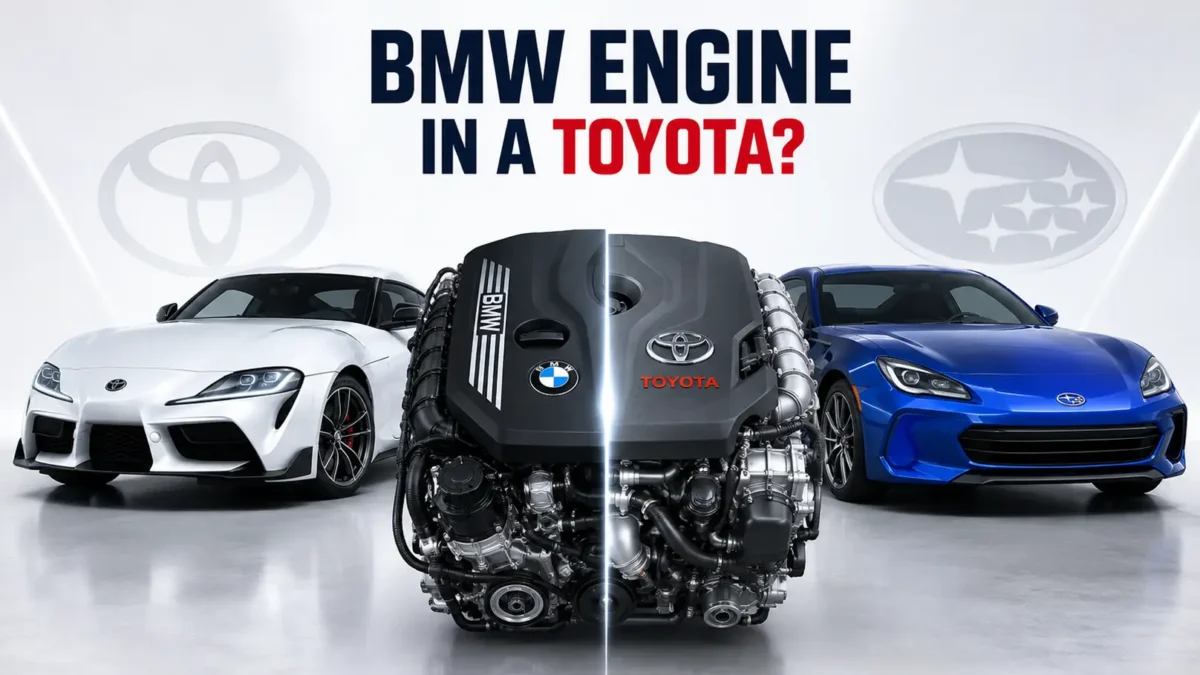
Table of Contents
- Which Toyotas Have BMW Engines?
- Which Toyotas Have Subaru Engines?
- Do Lexus and Toyota Have the Same Engines?
- So what’s the difference between a Lexus and Toyota engine?
- The practical upside for owners
- Other Toyota Engine Partnerships
- What This Means When You Need an Engine
- Common Myths
- Does Toyota use BMW engines?
- Which BMW engine is in the Toyota Supra?
- Do Lexus and Toyota have the same engine?
- What is the difference between a Lexus and Toyota engine?
- Do Lexus engines cost more than Toyota engines?
- Does the Toyota 86 use a Subaru engine?
- Can I put a Toyota engine in a Lexus?
- Why do carmakers share engines?
Yes — and it surprises a lot of people. The current Toyota Supra runs a BMW straight-six, the GR86 runs a Subaru boxer engine, and Lexus has been using Toyota engines since the brand launched. Modern carmakers share far more than most owners realise.
This matters beyond trivia. If you’re sourcing a replacement engine or ordering parts, knowing whose engine is actually in your car saves you time and money — and in a couple of cases, stops you ordering the wrong thing entirely.
Quick answer: The Toyota GR Supra uses BMW engines (the B58 3.0L inline-six and, in earlier models, the B48 2.0L four). The Toyota 86 and GR86 use Subaru boxer engines. Lexus is Toyota’s luxury brand and shares most of its engines with Toyota, though some are Lexus-specific and tuning often differs.
Which Toyotas Have BMW Engines?
Just one model line, but it’s a famous one.
The GR Supra, launched in 2020, was developed jointly with BMW and shares its platform with the BMW Z4. Under the bonnet is BMW’s B58 3.0-litre turbocharged inline-six, producing between 335 and 382 hp depending on year and market. Earlier models also offered BMW’s B48 2.0-litre turbo four at around 255 hp, though it was dropped for 2025 due to weak demand.
The partnership dates back to a 2011 agreement between the two companies, originally about environmental technology, which later expanded into sports car development. Building a new inline-six from scratch would have cost an enormous amount for a low-volume halo car — using BMW’s was the pragmatic call.
Worth knowing: Toyota did its own suspension, steering and chassis tuning, so the Supra doesn’t drive like a Z4 despite the shared hardware. Toyota also states it calibrated the engine itself.
One notable limit: Toyota reportedly wanted BMW’s hotter twin-turbo S58 (the M-car engine) for the Supra Final Edition, but BMW declined. The Final Edition instead got the most powerful B58 tune yet, at 429 hp — limited to 300 units worldwide.
Which Toyotas Have Subaru Engines?
The Toyota 86 and GR86 use Subaru’s FA-series boxer engine — the FA20 in the first generation, and the naturally aspirated FA24 2.4-litre in the current car, making 228 hp.
The 86 and the Subaru BRZ are twins: same platform, same engine, same outputs, with different bodywork and equipment. Toyota holds a stake in Subaru, and the partnership has since extended to shared electric vehicles.
Toyota’s contribution to the engine was its D-4S injection system, which combines direct and port injection — so it’s a genuine collaboration rather than a straight rebadge. But mechanically, it’s a Subaru boxer.
Do Lexus and Toyota Have the Same Engines?
Mostly yes, and this is the most commercially useful thing on this page.
Lexus is Toyota’s luxury division, not a separate manufacturer. It shares engineering, factories and a great many engines. Well-known examples:
- 2GR-FE / 2GR-FKS 3.5L V6 — Kluger, Aurion, Camry V6, and Lexus RX350, ES350
- 2JZ — Toyota Supra and Crown, plus Lexus IS300 and GS300
- 1UZ-FE / 3UZ-FE V8 — Toyota Crown and Soarer, plus Lexus LS400 and SC430
- A25A-FKS 2.5L — Camry and RAV4, plus Lexus ES250 and NX250
So what’s the difference between a Lexus and Toyota engine?
Where they differ, it usually comes down to four things:
| Difference | What it means |
| Tuning | Lexus versions are often tuned for refinement and slightly more power |
| Engine code suffix | A shared engine may carry a different code variant (e.g. FSE vs FE) |
| Ancillaries | Different intake, exhaust, ECU calibration and mounts |
| Exclusives | Some engines are Lexus-only and never appear in a Toyota |
Lexus-only engines include the 2UR-GSE 5.0-litre V8 used in F models like the IS500 and RC F, and the 1LR-GUE V10 built for the LFA supercar with Yamaha. You won’t find those in a Toyota.
The practical upside for owners
If you drive a Lexus with a shared engine, your sourcing options are wider than you might think. A 2GR-FE from a Kluger is the same fundamental engine as one from an RX350, and Toyota-sourced units are often cheaper and more plentiful than Lexus-badged ones.
The catch: the engine code and ancillaries still have to match your car. A shared block doesn’t guarantee a shared calibration, sensor set or mounting arrangement. Always verify by VIN and engine code rather than assuming.
Other Toyota Engine Partnerships
Sharing runs in both directions. A few examples worth knowing:
- Lotus used Toyota engines for years — the 2ZZ-GE in the Elise, and the 2GR-FE V6 in the Evora and Exige.
- Subaru and Toyota co-developed electric vehicles beyond the 86 partnership.
- Pontiac Vibe was mechanically a Toyota Matrix, sharing its engines.
- Aston Martin Cygnet was a rebodied Toyota iQ, complete with Toyota engine.
The general pattern: engine development is enormously expensive, so manufacturers share to spread the cost — especially on low-volume models.
What This Means When You Need an Engine
Here’s where it gets practical. Before sourcing a replacement, work out whose engine you actually need:
| Your vehicle | Engine you need | Where to look |
| GR Supra (2020 on) | BMW B58 or B48 | BMW supply chain, not Toyota |
| Toyota 86 / GR86 | Subaru FA20 or FA24 | Subaru supply chain |
| Lexus with a shared engine | Toyota equivalent often works | Toyota units — often cheaper |
| Any other Toyota | Toyota engine | Standard Toyota sourcing |
Three things to check before you buy:
- Match the engine code, not the badge. The brand on the bonnet doesn’t tell you who built the engine.
- Confirm ancillaries and calibration. Shared engines can carry different sensors, ECUs and mounts between brands.
- Verify by VIN. It’s the only definitive answer, and it takes a minute.
If you’re not sure which engine your vehicle uses, send us your VIN and we’ll confirm exactly what fits — including whether a Toyota-sourced unit will work in your Lexus.
Common Myths
- “A BMW engine makes the Supra not a real Toyota.” Toyota handled its own chassis and calibration work, and shared engineering is standard practice across the industry.
- “Lexus engines are completely different from Toyota’s.” Most are the same engine families, often with different tuning. A handful are genuinely Lexus-only.
- “Any Toyota engine will fit a Lexus with the same capacity.” No. Codes, ancillaries and calibration have to match.
- “Shared engines mean lower quality.” The B58 has appeared repeatedly on international best-engine lists, and the shared Toyota–Lexus V6s are among the most reliable engines built.
Does Toyota use BMW engines?
Yes, in one model. The GR Supra, launched in 2020, uses BMW’s B58 3.0-litre turbocharged inline-six, and earlier versions also offered BMW’s B48 2.0-litre four. It shares its platform with the BMW Z4, though Toyota did its own chassis and calibration tuning.
Which BMW engine is in the Toyota Supra?
The B58 3.0-litre single-turbo inline-six, producing 335–382 hp depending on year and market. The Final Edition raised this to 429 hp. Toyota reportedly requested BMW’s twin-turbo S58 but was declined.
Do Lexus and Toyota have the same engine?
In most cases, yes. Lexus is Toyota’s luxury division and shares many engine families, including the 2GR V6, 1UZ V8 and A25A four-cylinder. Some engines are Lexus-exclusive, such as the 2UR-GSE V8 and the LFA’s V10.
What is the difference between a Lexus and Toyota engine?
Where they share a family, differences usually come down to tuning, ECU calibration, ancillaries and sometimes an engine code variant. Lexus versions are often tuned for refinement or slightly higher output.
Do Lexus engines cost more than Toyota engines?
Lexus-badged units are often more expensive and less common in the replacement market. Where the engine family is shared, a Toyota-sourced equivalent can be a more affordable option — provided the engine code and ancillaries match your vehicle.
Does the Toyota 86 use a Subaru engine?
Yes. The 86 and GR86 use Subaru’s FA-series boxer engine — the FA20 originally, and the 2.4-litre FA24 in the current car. Toyota contributed its D-4S injection system, and the car is a twin to the Subaru BRZ.
Can I put a Toyota engine in a Lexus?
Often yes, where the engine family is shared, but only if the engine code, sensors, ECU calibration and mounts match. Verify by VIN before purchasing rather than assuming a shared capacity means a shared fit.
Why do carmakers share engines?
Developing a new engine costs an enormous amount, and low-volume models can’t recover that on their own. Sharing spreads the cost, which is why the Supra uses a BMW six and the GR86 uses a Subaru boxer.

Looking for this part?
Send one enquiry and reach Australian suppliers who handle your vehicle.
Request a quote