McLaren F1 Engine Supplier: Mercedes Power in 2026
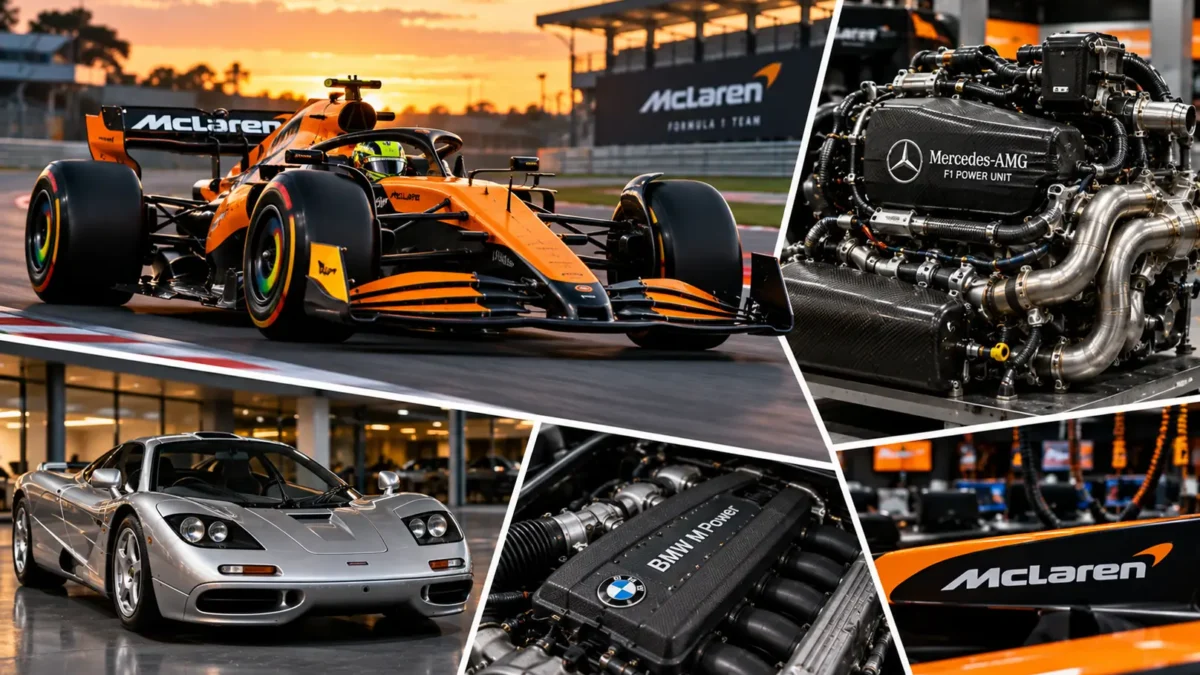
Table of Contents
- Quick Answer: What Engine Does McLaren F1 Use?
- McLaren F1 Engine Supplier at a Glance
- Who Supplies McLaren’s F1 Engines?
- F1 Team or McLaren F1 Road Car?
- What Engine Does McLaren Use in 2026?
- McLaren F1 Power-Unit Specifications
- Does McLaren Use Mercedes Engines?
- McLaren F1 Engine Supplier History
- What Engine Did McLaren Use in 2025?
- Who Supplies McLaren F1’s Fuel?
- Who Makes McLaren Engines?
- Who Designs and Builds McLaren Road-Car Engines?
- McLaren Engines by Road-Car Model
- How to Check an Engine Claim
- McLaren F1 Engine FAQs
- What engine does McLaren F1 use?
- Does McLaren F1 use Mercedes engines?
- Does McLaren make its own F1 engine?
- What engine did McLaren use in 2025?
- How long does McLaren’s Mercedes deal last?
- Who supplied McLaren’s F1 engines before Mercedes returned in 2021?
- Who supplies McLaren F1’s fuel?
- What engine is in the McLaren F1 road car?
- Who makes engines for McLaren road cars?
- Does McLaren use Mercedes engines in its road cars?
- What changed in McLaren’s F1 engine for 2026?
McLaren’s Formula 1 team uses Mercedes-AMG power units. McLaren’s own technical specification for the 2026 MCL40 (published 11 February 2026) lists the power unit as the Mercedes-AMG F1 M17 E PERFORMANCE, and McLaren builds the car around it. The question gets confusing because “McLaren F1” is also the name of a 1990s road car, and that car used a BMW V12, not a Mercedes engine. This guide answers the racing question first, then separates the road cars, sets out the supplier history and covers fuel. Every fact carries its source and date, and where we could not confirm something, such as the fuel supplier, we say so. For the other side of the story, see our guide to the Mercedes F1 engines, and for everyday cars see our engine replacement cost guide.
Quick Answer: What Engine Does McLaren F1 Use?
- 2026 F1 car: the Mercedes-AMG F1 M17 E PERFORMANCE, supplied by Mercedes-AMG (McLaren technical specification, 11 February 2026).
- 2025 F1 car: the Mercedes-AMG M16 E Performance (McLaren technical specification, 17 February 2025).
- Supply deal: McLaren said on 24 November 2023 that it will use Mercedes-AMG power from 2026 to 2030, after using Mercedes-AMG power since 2021 and from 1995 to 2014.
- Own engine: we found no source saying McLaren builds its own F1 engine. It builds the car, and Mercedes supplies the power unit.
- Fuel: news outlets report that Petronas supplies the fuel for the Mercedes-powered cars, including McLaren’s, but we found no official McLaren, Petronas or FIA statement confirming it. McLaren’s specification pages name no fuel supplier.
- The road car: the 1990s McLaren F1 road car used the BMW S70/2 V12, according to BMW M (20 December 2024).
- Other road cars: McLaren’s newer V8 is designed in-house and manufactured by Ricardo, according to a Ricardo release dated 9 May 2023. Check each model, because that release does not cover every car.
McLaren F1 Engine Supplier at a Glance
1. McLaren F1 team, 2026
- Power unit: Mercedes-AMG F1 M17 E PERFORMANCE
- Layout: 1.6 litre, six cylinders, 90 degree vee, with a hybrid system (McLaren, 11 February 2026)
- Watch for: the page gives the MGU-K’s 350 kW peak but not the total power unit output
2. McLaren F1 team, 2025
- Power unit: Mercedes-AMG M16 E Performance
- Layout: 1.6 litre, six cylinders, 90 degree vee, with an MGU-K of 120 kW and an MGU-H (McLaren, 17 February 2025)
- Watch for: the 2025 and 2026 units are different designs under different rules
3. The supply agreement
- Term: Mercedes-AMG power from 2026 to 2030 (McLaren, 24 November 2023)
- History: Mercedes power since 2021, and a continuous earlier period from 1995 to 2014
- Watch for: the announcement gives no financial terms and does not say whether the deal is exclusive
4. The McLaren F1 road car
- Engine: BMW S70/2, a 6.1 litre (6,064 cc) V12 rated at 627 hp (BMW M)
- Era: 1990s road car, not the racing team
- Watch for: searches for “McLaren F1 engine” can mean either one
5. Other McLaren road cars
- Engine: the new V8 is designed in-house by McLaren’s powertrain team and manufactured by Ricardo (Ricardo, 9 May 2023)
- Watch for: one supplier does not cover every model, so check each car
6. Fuel and lubricants
- Fuel: reported as Petronas by news outlets, not confirmed by an official source we could read
- Lubricants: Motul supplies high-performance transmission lubricants from 2026 (Motul, 15 September 2025)
Who Supplies McLaren’s F1 Engines?
Mercedes supplies the power unit and McLaren builds the car. The McLaren F1 engine supplier in 2026 is Mercedes-AMG, and the unit is named in McLaren’s own specification for the MCL40.
What the sources say
- McLaren’s specification (11 February 2026): the MCL40’s power unit is the “Mercedes-AMG F1 M17 E PERFORMANCE”
- McLaren’s agreement announcement (24 November 2023): “the McLaren F1 Team will continue to enjoy Mercedes-AMG power from 2026 to 2030”
- McLaren’s website (5 August 2026): Neil Houldey, quoted in an article on how the MCL40 has evolved, refers to Mercedes-AMG High Performance Powertrains (HPP) delivering to the team. The article does not state the supply arrangement outright
- The racing car: McLaren designs and races the MCL40 itself. The specification page we read lists the car’s monocoque and weight alongside the supplied power unit
What “supplier” means in F1
In Formula 1 a power unit is the engine plus the hybrid system that works with it. A customer team such as McLaren buys the power unit from a manufacturer and builds its own car around it. McLaren’s agreement announcement describes the arrangement as a “power unit deal”. We found no source saying McLaren makes the power unit itself.
F1 Team or McLaren F1 Road Car?
Two different things share the name, and the engines have nothing in common.
McLaren F1 team (Formula 1 racing)
- Engine: a Mercedes-AMG hybrid power unit, the M17 E PERFORMANCE in 2026
- Built by: Mercedes-AMG, with McLaren building the car
- Typical search: “what engine does McLaren F1 use”, “McLaren F1 engine supplier”
McLaren F1 road car (1990s)
- Engine: the BMW S70/2 V12. BMW M’s engine history page (20 December 2024) lists it as a 6,064 cm³ engine rated at 627 hp and says BMW M put it in the “exclusive super sportscar McLaren F1”. It says only about 100 of the S70/2 were built
- Production years: Wikipedia gives 1992 to 1998 and credits Paul Rosche of BMW M with the engine. That is a secondary source, so check before quoting it
- Typical search: “McLaren F1 engine BMW V12”
Other McLaren road cars
- Engine: see “Who Makes McLaren Engines?” below
- Typical search: “who makes engines for McLaren road cars”
If your search was “McLaren F1 engine” with no other words, either meaning could fit. This page covers the racing team in detail and gives the road-car answer in short form.
What Engine Does McLaren Use in 2026?
In 2026 McLaren uses the Mercedes-AMG F1 M17 E PERFORMANCE in the MCL40. McLaren’s technical specification page, dated 11 February 2026, lists it as the car’s power unit.
This answer is dated, because power units change with the rules and with each season’s development. The 2026 season is the first under new power-unit regulations (see the next section), and the unit’s name has changed from last year’s. If you are reading this after the 2026 season, check McLaren’s current specification page before quoting it.
McLaren F1 Power-Unit Specifications
McLaren’s 2026 specification page (11 February 2026) lists these power-unit details.
Engine (the combustion part)
- Capacity and layout: 1.6 litres, six cylinders, 90 degree vee
- Valves: 24
- Fuel injection: high-pressure direct injection, up to 350 bar, with one injector per cylinder
- Turbo: a single-stage compressor and exhaust turbine on a common shaft, with a turbine limit of 150,000 rpm
Hybrid system
- Layout: integrated hybrid energy recovery through an electric MGU-K coupled to the crankshaft
- MGU-K: maximum power 350 kW, maximum speed 60,000 rpm, and 9 MJ per lap of energy recovery and deployment
- Energy store: a lithium-ion battery with a maximum energy storage of 4 MJ per lap and a minimum regulation weight of 35 kg
Fuel flow
- Limit: a maximum fuel energy flow of 3,000 MJ/h above 10,500 rpm
What the page does not say
- The total power unit output, the combustion engine’s own output and torque are not given
- A maximum engine speed is not given
- No fuel supplier or fuel type is named
What changed for 2026 (Formula 1 website, 14 January 2026)
- The 2026 power unit “retains the 1.6-litre turbocharged V6 engine” with a few tweaks, according to the Formula 1 explainer. It does not say what the tweaks are
- The MGU-H is deleted
- The MGU-K is nearly three times as powerful, delivering 350 kW, up from 120 kW
- The goal is to raise the electric share of power from around 20 per cent to around 50 per cent. That is a target stated in the article, not a measured figure
- All teams use Advanced Sustainable Fuels in 2026. The article does not say “100 per cent sustainable”, so we do not use that phrase
For the earlier unit, McLaren’s 2025 page lists the MGU-K at 120 kW and an MGU-H, which matches the contrast above.
Does McLaren Use Mercedes Engines?
Yes, in Formula 1. McLaren’s Formula 1 team uses Mercedes-AMG power units. It is a supply deal for the racing team and does not cover the road cars. Ownership questions are a separate topic and are not answered here.
The Formula 1 relationship
- Customer supply: McLaren buys its power units from Mercedes-AMG. The agreement announced on 24 November 2023 covers 2026 to 2030
- Length of the relationship: McLaren’s announcement says 2026 will mark the 26th year of collaboration between the two brands. That matches 1995 to 2014 plus 2021 to 2026
- Quote: Mercedes’ chief technology officer Markus Schaefer said Mercedes is “delighted to continue our partnership with McLaren Racing to at least the end of this decade”
- What is not public: the announcement gives no financial terms and does not say whether the deal is exclusive
Keeping the road cars separate
- The agreement is about Formula 1 power units. It says nothing about McLaren’s road cars
- The one McLaren-badged road car we found with a Mercedes-linked engine is the Mercedes-Benz SLR McLaren (see “McLaren Engines by Road-Car Model” below)
McLaren and its own F1 engine
We found no source saying it does. McLaren designs the racing car and Mercedes supplies the power unit. We do not speculate about future engines, and the supply deal runs to 2030.
McLaren F1 Engine Supplier History
McLaren has not always used Mercedes. The verified recent timeline, with the source for each period, is below.
Timeline
- 1995 to 2014, Mercedes: McLaren’s announcement of 24 November 2023 notes an earlier, continuous period of Mercedes supply from 1995 to 2014
- 2015 to 2017, Honda: The Drive (12 September 2017) says McLaren and Honda “rejoined in 2015” and had officially decided to end the partnership after 2017
- 2018 to 2020, Renault: the same article says McLaren signed a Renault deal that lasts through the 2020 season. PlanetF1 (28 September 2019) reports that the Renault relationship would end at the conclusion of the 2020 season
- 2021 to now, Mercedes: PlanetF1 (28 September 2019) reports McLaren confirming a return to Mercedes power for 2021. McLaren’s 2023 announcement says it has used Mercedes-AMG power since 2021 and extends the deal to 2030
Before 1995
McLaren has raced in Formula 1 since 1966 and used other suppliers in that period. We did not verify those seasons for this guide, so we give no names or years for them.
What Engine Did McLaren Use in 2025?
This section is historical. In 2025 McLaren used the Mercedes-AMG M16 E Performance, according to McLaren’s MCL39 technical specification (17 February 2025).
2025 power unit, as McLaren lists it
- Layout: 1.6 litres, six cylinders, 90 degree vee, 24 valves
- Maximum engine speed: 15,000 rpm
- Fuel injection: high-pressure direct injection, up to 500 bar, one injector per cylinder
- Hybrid system: an MGU-K with a maximum power of 120 kW, an MGU-H, and an energy store of 4 MJ per lap
- Fuel flow: a maximum of 100 kg per hour above 10,500 rpm
- Not stated: total power output, and any fuel type, blend or supplier
How it compares with 2026
- The MGU-K peak rises from 120 kW to 350 kW, and the MGU-H is deleted (McLaren’s two specification pages and the Formula 1 explainer of 14 January 2026)
- Injection pressure is listed at up to 500 bar in 2025 and up to 350 bar in 2026
- The fuel limit is expressed differently: 100 kg per hour in 2025 and 3,000 MJ/h in 2026, both above 10,500 rpm. We do not convert one into the other
The unit’s name also changed, from M16 E Performance to M17 E PERFORMANCE. We give the names as McLaren prints them.
Who Supplies McLaren F1’s Fuel?
Fuel and engine supply are separate questions. The engine is supplied by Mercedes-AMG. For fuel, we could not confirm an answer from an official source, and we say so plainly.
What is confirmed
- McLaren’s 2026 specification page (11 February 2026) gives a maximum fuel energy flow but does not name a fuel type or a fuel supplier
- McLaren’s 2025 specification page (17 February 2025) gives a maximum fuel flow and does not name a fuel type, blend or supplier
- The Formula 1 explainer (14 January 2026) says all teams use Advanced Sustainable Fuels in 2026, independently certified to meet strict sustainability standards
What is reported but not officially confirmed
- GPblog (23 December 2025) lists Petronas as the fuel provider for Mercedes power units, with Mercedes, McLaren, Williams and Alpine as the teams. The article cites no official statement for that pairing
- Motorsport.com, in an article from the days before the 2026 Australian Grand Prix, reported that the FIA had approved Petronas sustainable fuel for the Mercedes engines used by Mercedes, McLaren, Williams and Alpine. It also reported that the approval had been delayed, and it noted that Petronas and Mercedes had not commented
- GrandPrix247 (18 February 2026) describes “eight Petronas-fueled Mercedes-powered cars”, relying on that Motorsport.com reporting
Why we do not state it as fact
- Petronas is the Mercedes team’s fuel and oil partner and title sponsor. A sponsor relationship alone does not establish who supplies a different team’s fuel
- We found no statement from McLaren, Petronas or the FIA naming McLaren’s fuel supplier
Lubricants
- Motul joined the McLaren Formula 1 team from the 2026 season to provide high-performance transmission lubricants (Motul press release, 15 September 2025). That release does not mention fuel, and it does not describe engine oil
We did not find a source for the 2025 fuel supplier. Check McLaren’s partner pages for a current statement before quoting any fuel supplier.
Who Makes McLaren Engines?
It depends on which McLaren you mean. The three answers below are the ones most people are after.
McLaren F1 team
- Engine: Mercedes-AMG hybrid power unit
- Source: McLaren, 11 February 2026
Classic McLaren F1 road car
- Engine: BMW S70/2 V12, built by BMW M
- Source: BMW M’s engine history page, 20 December 2024
Newer McLaren road cars
- Engine: designed in-house by McLaren’s powertrain team and manufactured by Ricardo, for the new V8
- Source: a Ricardo release dated 9 May 2023, which says Ricardo has built both the V6 and V8 engines for McLaren, at its plant in Shoreham-by-Sea in the United Kingdom, and delivers them to McLaren’s Production Centre in Woking
Who Designs and Builds McLaren Road-Car Engines?
The Ricardo release gives the clearest dated answer we found.
- Design: the release says the new V8 is “designed in-house by McLaren’s powertrain team”
- Manufacture: Ricardo manufactures the engines and says it has produced over 34,000 McLaren powertrains at its Shoreham-by-Sea facility
- Scale of the arrangement: the release calls the new deal the third extension and fourth generation of the two companies’ engine supply agreement
- What it does not say: it names only the 12C, which it describes as McLaren’s first series production supercar (introduced in 2011), and it does not name the cars that will use the new V8. It gives no V6 design details, and it gives no agreement dates or contract value
Treat one supplier as a guide, not a rule for every model. Check the car you are asking about.
McLaren Engines by Road-Car Model
We checked the arrangement for the cars below only as far as the sources allow. Where we have no verified detail, we give none.
Mercedes-Benz SLR McLaren (sold 2003 to 2010)
- Engine: a supercharged 5.4 litre (5,439 cc) V8, which Wikipedia calls the “SLR AMG V8” and describes as hand-built
- Power: 626 PS in the standard car, according to the same page
- Note: this is a secondary source. The page does not name the company that built the engine, so check before quoting who built it
McLaren 570S, 600LT, 720S, 765LT and McLaren GTS
- Engine code and manufacturer: we did not verify these model by model, so we give none
- What the Ricardo release covers: it says Ricardo built both the V6 and the V8 engines for McLaren, and names only the 12C. It does not list the cars above
- What to do: check McLaren’s own specification for the exact model and year
How to Check an Engine Claim
Engine claims go out of date quickly, and a few habits catch most mistakes.
- Pick the meaning first: is it the racing team or a road car? “McLaren F1” can be either
- Check the season: the power unit name changes between years, as the M16 E Performance and M17 E PERFORMANCE show
- Use the car’s own specification page: McLaren publishes one for each Formula 1 car, and it lists the power unit by name
- Treat sponsors and fuel with care: a logo on a page, or a sponsor of another team, does not tell you who supplies a team’s fuel
- Look at the date: a news article from 2017 describes Honda and Renault, not the current supplier
McLaren F1 Engine FAQs
What engine does McLaren F1 use?
In 2026 McLaren’s Formula 1 team uses the Mercedes-AMG F1 M17 E PERFORMANCE, according to McLaren’s MCL40 technical specification (11 February 2026). It is a 1.6 litre, six cylinder, 90 degree vee hybrid power unit supplied by Mercedes-AMG. The “McLaren F1” road car of the 1990s used a different engine, the BMW S70/2 V12.
Does McLaren F1 use Mercedes engines?
Yes. McLaren said on 24 November 2023 that its Formula 1 team will use Mercedes-AMG power from 2026 to 2030. It has used Mercedes-AMG power since 2021 and also from 1995 to 2014. The deal covers Formula 1 power units, and it does not say which engines McLaren’s road cars use.
Does McLaren make its own F1 engine?
We found no source saying it does. McLaren builds its Formula 1 car and Mercedes-AMG supplies the power unit. For road cars the position is different: Ricardo’s release of 9 May 2023 says the new V8 is designed in-house by McLaren and manufactured by Ricardo. We do not speculate about future engines.
What engine did McLaren use in 2025?
The Mercedes-AMG M16 E Performance, according to McLaren’s MCL39 technical specification (17 February 2025). McLaren lists it as a 1.6 litre, six cylinder unit with a maximum speed of 15,000 rpm, an MGU-K of up to 120 kW and an MGU-H. This is historical, because the 2026 car uses a new unit.
How long does McLaren’s Mercedes deal last?
McLaren’s announcement of 24 November 2023 says Mercedes-AMG power from 2026 to 2030. It gives no financial terms and does not say whether the deal is exclusive. Check McLaren’s website for any later change.
Who supplied McLaren’s F1 engines before Mercedes returned in 2021?
Renault supplied McLaren from 2018 to 2020, and Honda from 2015 to 2017, according to The Drive (12 September 2017) and PlanetF1 (28 September 2019). Mercedes supplied McLaren from 1995 to 2014. We did not verify the seasons before 1995.
Who supplies McLaren F1’s fuel?
We could not confirm it from an official source. News outlets, including GPblog (23 December 2025) and Motorsport.com, report Petronas as the fuel for the Mercedes-powered cars, which include McLaren. McLaren’s specification pages name no fuel supplier. Motul supplies McLaren’s transmission lubricants from 2026, but that is not fuel.
What engine is in the McLaren F1 road car?
The BMW S70/2, a 6.1 litre (6,064 cc) V12 rated at 627 hp, built by BMW M, according to BMW M’s engine history page (20 December 2024). That page says only about 100 of the S70/2 were built. This is the 1990s road car, not the Formula 1 team.
Who makes engines for McLaren road cars?
It depends on the model. Ricardo’s release of 9 May 2023 says the new V8 is designed in-house by McLaren’s powertrain team and manufactured by Ricardo at Shoreham-by-Sea, and that Ricardo has built both the V6 and V8 engines for McLaren. The classic F1 road car used a BMW V12 and the Mercedes-Benz SLR McLaren used a supercharged V8. Check each model.
Does McLaren use Mercedes engines in its road cars?
Not as a general rule that we could verify. The Formula 1 agreement covers racing power units only. The Mercedes-Benz SLR McLaren (sold 2003 to 2010) used a supercharged 5.4 litre V8 that Wikipedia calls the “SLR AMG V8”, but that is one car, and we did not verify the engine arrangement for McLaren’s current road cars.
What changed in McLaren’s F1 engine for 2026?
According to the Formula 1 explainer of 14 January 2026, the 1.6 litre turbocharged V6 is retained with a few tweaks, the MGU-H is deleted, and the MGU-K rises from 120 kW to 350 kW. All teams use Advanced Sustainable Fuels. McLaren’s specification lists the unit as the Mercedes-AMG F1 M17 E PERFORMANCE.

Looking for this part?
Send one enquiry and reach Australian suppliers who handle your vehicle.
Request a quote