Toyota 2ZR Engine Guide: Specs, Problems, Models and Reliability
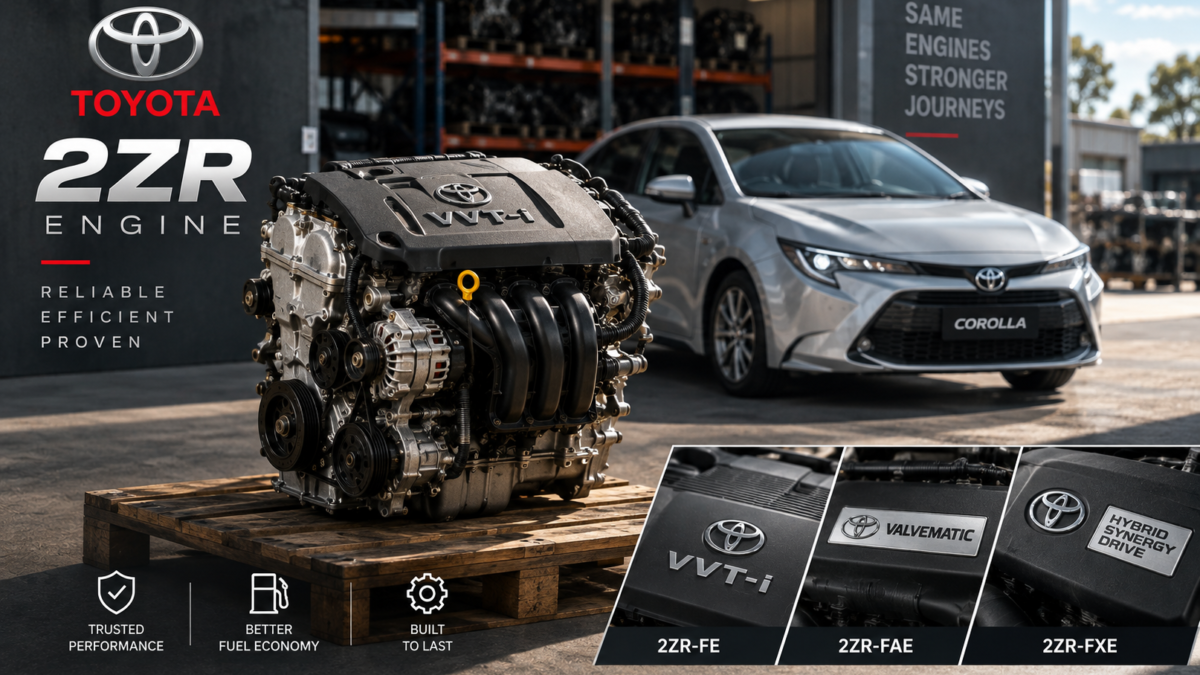
Table of Contents
- Toyota 2ZR Engine at a Glance
- What Is the Toyota 2ZR Engine?
- Toyota 2ZR Engine Codes and Variants
- 2ZR-FE
- 2ZR-FAE
- 2ZR-FXE
- Which Cars Use the Toyota 2ZR Engine?
- Toyota Corolla and the 2ZR Engine
- Corolla ZR is a grade, not an engine code
- Toyota 2ZR-FE Engine Specs
- Toyota 2ZR-FE Engine Problems
- Oil consumption on early builds
- Water pump failure
- Valvematic faults (2ZR-FAE)
- VVT-i actuator and solenoid faults
- General age-related items
- Is the Toyota 2ZR-FE a Reliable Engine?
- 2ZR-FE vs 2ZR-FAE vs 2ZR-FXE
- Are Toyota 2ZR Engines Interchangeable?
- How to Identify the Correct Toyota 2ZR Replacement Engine
- What to Check When Buying a Used Toyota 2ZR Engine
- What is a Toyota 2ZR engine?
- What size is the Toyota 2ZR engine?
- Is the Toyota 2ZR-FE a good engine?
- What cars have the Toyota 2ZR-FE engine?
- What are common Toyota 2ZR-FE engine problems?
- How long does a Toyota 2ZR engine last?
- Are 2ZR-FE and 2ZR-FXE the same engine?
- Can I replace a 2ZR-FE with another 2ZR engine?
- How do I identify my Toyota engine code?
The Toyota 2ZR engine is a 1.8-litre naturally aspirated four-cylinder from Toyota’s ZR family, built with an aluminium block, twin overhead cams and variable valve timing. It replaced the older 1ZZ-FE from around 2007 and went on to power millions of cars — which is exactly why you’ve probably ended up here.
If you own a Corolla built between roughly 2007 and 2019, there’s a good chance a 2ZR-FE Toyota engine is sitting under the bonnet. The same family also turns up in hybrids and a handful of non-Toyota vehicles.
This guide covers what the engine is, how the variants differ, which Australian models use them, the faults worth knowing about, and — the part that trips people up most — how to work out exactly which 2ZR you need if you’re buying a replacement.
Toyota 2ZR Engine at a Glance
| Specification | Toyota 2ZR Details |
|---|---|
| Engine family | Toyota ZR series |
| Common engine codes | 2ZR-FE, 2ZR-FAE, 2ZR-FXE (2ZR-FBE in flex-fuel markets) |
| Displacement | 1.8 L (1,798 cc) |
| Configuration | Inline four-cylinder, transverse |
| Bore × stroke | 80.5 mm × 88.3 mm |
| Compression ratio | 10.0:1 (FE), 10.5:1 (FAE), 13.0:1 (FXE) |
| Fuel system | Multi-point electronic fuel injection |
| Aspiration | Naturally aspirated |
| Valvetrain | DOHC, 16-valve, chain-driven, Dual VVT-i (VVT-i intake only on FXE) |
| Fuel type | Unleaded petrol |
| Approx. power range | Roughly 71–110 kW depending on variant and market |
| Approx. torque range | Roughly 142–175 Nm depending on variant |
| Common applications | Corolla, Corolla Hybrid, Prius, C-HR Hybrid, Lexus CT200h |
Figures vary by variant, market and build year. Treat the table as a guide and confirm against your own vehicle’s details.
What Is the Toyota 2ZR Engine?
The ZR family is Toyota’s line of small four-cylinder petrol engines spanning roughly 1.6 to 2.0 litres. The 2ZR sits in the middle at 1.8 litres, and it’s the most widely used member of the family.
It’s a fairly conventional design, and that’s a large part of why it works. Aluminium block with cast-iron cylinder liners, aluminium head, double overhead camshafts, four valves per cylinder, and a timing chain rather than a belt — so there’s no scheduled belt replacement to budget for.
The clever part is the valve timing. Most 2ZR variants use Dual VVT-i, adjusting both intake and exhaust cam timing to suit engine load. Some versions add Valvematic, which continuously varies how far the intake valves open. Both systems chase the same goal: decent economy without giving up drivability.
Production began around 2007, and the engine remained in service well into the 2010s across petrol and hybrid applications. In Australia it’s most closely associated with the Corolla.
One thing worth knowing upfront: the 2ZR is an interference engine. If the timing chain were to jump, pistons and valves can meet. Chain failure is genuinely rare when oil changes are kept up, but it’s a reason not to let servicing slide.
Toyota 2ZR Engine Codes and Variants
This is where most confusion starts. “2ZR” on its own doesn’t identify an engine precisely enough to order one. The suffix matters enormously.
2ZR-FE
The baseline version, and the one people mean when they search for a 2ZR-FE Toyota engine.
It runs Dual VVT-i on both camshafts, port fuel injection, and a 10.0:1 compression ratio. Output sits around 98–103 kW at 6,000 rpm with roughly 173 Nm at 4,400 rpm, though this shifts a little by market and model year.
It’s the most commonly searched 2ZR for a simple reason — volume. Toyota fitted it to the Corolla through two generations, plus various models sold overseas. There are a lot of them on Australian roads, and a healthy supply in the used engine market as a result.
2ZR-FAE
Mechanically similar to the FE, with one significant addition: Valvematic.
Valvematic continuously varies intake valve lift, on top of the Dual VVT-i timing adjustment. The practical result is around 5–10% better fuel consumption and slightly more power — typically 104–110 kW at 6,600 rpm, with about 171–175 Nm at 4,000 rpm. Compression rises marginally to 10.5:1.
The catch for anyone sourcing an engine: Valvematic brings extra hardware, including its own actuator and control system. An FAE and an FE are not a straight swap for one another, even though the block architecture is shared.
2ZR-FXE
The hybrid variant, and the most different of the three despite the shared family name.
The FXE runs the Atkinson cycle rather than the conventional Otto cycle. Intake valves stay open later into the compression stroke, which lowers effective compression while keeping a full expansion stroke. That improves thermal efficiency at the cost of outright power. Compression is a much higher 13.0:1, it uses VVT-i on the intake camshaft only, and it adds a cooled EGR system.
Output is modest on its own — roughly 71–73 kW and around 142 Nm — because it was never meant to work alone. It’s designed to run alongside electric motors within Toyota’s hybrid system, and to spend its time in its most efficient rev range.
An FXE is not a substitute for an FE. Different cycle, different compression, different control strategy, and it’s built to be part of a hybrid driveline. Fitting one to a conventional petrol car isn’t a matter of bolting it in.
There’s also a 2ZR-FBE, a flex-fuel version built for markets running high-ethanol blends. It isn’t an Australian-market engine, but it’s worth knowing it exists if you come across the code in an overseas listing.
| Engine Code | Capacity | Technology | Typical Application | Key Difference |
|---|---|---|---|---|
| 2ZR-FE | 1.8 L | Dual VVT-i | Corolla petrol | The baseline; most common |
| 2ZR-FAE | 1.8 L | Dual VVT-i + Valvematic | Later Corolla petrol | Variable valve lift, extra hardware |
| 2ZR-FXE | 1.8 L | Atkinson cycle, VVT-i intake only | Corolla Hybrid, Prius, C-HR Hybrid | Hybrid-specific, 13.0:1 compression |
| 2ZR-FBE | 1.8 L | Flex-fuel calibration | Overseas ethanol markets | Not sold new in Australia |
Sharing the “2ZR” prefix tells you the family. It does not tell you the parts interchange.
Which Cars Use the Toyota 2ZR Engine?
| Toyota Model | Engine Code | Approx. Years | Notes |
|---|---|---|---|
| Corolla (ZRE150/ZRE152 series) | 2ZR-FE | 2007–2013 | The core Australian application |
| Corolla (E170/E180 series) | 2ZR-FE / 2ZR-FAE | 2012–2019 | Variant differs by build and grade — verify, don’t assume |
| Corolla Hybrid | 2ZR-FXE | 2016–2019 | Hybrid driveline; not interchangeable with petrol |
| Prius (ZVW30) | 2ZR-FXE | 2009–2015 | Hybrid |
| Prius v | 2ZR-FXE | 2012–2017 | Hybrid |
| C-HR Hybrid | 2ZR-FXE | 2020 onward | Hybrid |
| Lexus CT200h | 2ZR-FXE | 2011–2017 | Lexus-badged, same engine family |
Overseas applications (not Australian-delivered) include the Toyota Matrix, Scion xD, Toyota Auris, and various Japanese-market models such as the Allion and Premio. Lotus also used a 2ZR in some Elise variants. These matter only if you’re looking at an imported vehicle or an overseas engine listing — specification and emissions equipment can differ from Australian-delivered cars.
A warning that applies across the board: don’t assume every trim of a model shares an engine. Toyota changed engines within model runs and between grades more often than people expect.
Toyota Corolla and the 2ZR Engine
The Corolla is where most 2ZR questions originate, so it’s worth going through properly.
The ZRE150 and ZRE152 series (roughly 2007–2013) introduced the 2ZR-FE to Australian Corollas, replacing the older 1.8-litre 1ZZ-FE. These are the cars most commonly in the used-engine market today.
The following E170/E180 generation continued with 1.8-litre 2ZR engines, but this is where it gets less tidy — depending on build and grade, you may find either a 2ZR-FE or the Valvematic 2ZR-FAE. Two Corollas of the same year can carry different engines.
From 2016, the Corolla Hybrid arrived with the 2ZR-FXE. Same displacement, same family, entirely different engine in practice.
So year and model alone genuinely aren’t enough. A “2014 Corolla 1.8” could be one of several things.
Corolla ZR is a grade, not an engine code
This one causes real, expensive mistakes.
In Australia, ZR is a trim level — Toyota’s higher-specification Corolla grade, sitting above Ascent, Ascent Sport and SX. It refers to equipment: alloys, upgraded interior, extra features.
2ZR is an engine code. Completely separate thing.
The two are not connected, and here’s the part that catches people out: from the 2019 E210 generation, a Corolla ZR hatch is commonly fitted with the 2.0-litre M20A-FKS engine — not a 2ZR at all. So someone shopping for a “Corolla ZR engine” could easily end up ordering the wrong unit entirely.
If you’re searching for a car to buy, “Corolla ZR” is the right term. If you’re searching for an engine, you want the engine code.
Toyota 2ZR-FE Engine Specs
| Specification | 2ZR-FE Detail |
|---|---|
| Engine code | 2ZR-FE |
| Capacity | 1,798 cc (1.8 L) |
| Configuration | Inline four, transverse, naturally aspirated |
| Bore | 80.5 mm |
| Stroke | 88.3 mm |
| Compression ratio | 10.0:1 |
| Block | Aluminium with cast-iron cylinder liners |
| Cylinder head | Aluminium, DOHC, 16 valves |
| Valvetrain | Chain-driven, Dual VVT-i |
| Fuel delivery | Multi-point electronic fuel injection |
| Aspiration | Naturally aspirated |
| Power | Approx. 98–103 kW at 6,000 rpm |
| Torque | Approx. 173 Nm at 4,400 rpm |
| Firing order | 1-3-4-2 |
| Engine oil | Typically 0W-20; capacity around 4.2 L with filter |
Power, torque and oil specification vary by market, model and production year. Always check the figures against your own vehicle’s service documentation rather than relying on a general table.
Toyota 2ZR-FE Engine Problems
The 2ZR-FE has a good reputation, and it’s deserved. But a few issues come up often enough to be worth understanding — particularly if you’re buying a used car or a used engine.
To be clear: these are known concerns on some engines, concentrated in particular build years. Most 2ZR-FE engines never develop them.
Oil consumption on early builds
Symptoms: Oil level dropping noticeably between services, low oil warning light, occasional blue smoke on start-up or under acceleration.
Possible cause: Piston ring sealing on certain early builds — broadly the 2009–2011 period, with some 2012–2013 examples affected. Toyota issued a technical service bulletin acknowledging the ring design on affected engines, with piston ring replacement as the remedy.
What to check: Monitor oil level between services rather than only at them. On a used purchase, service history and an oil consumption check are worth the effort. Later builds are substantially less affected.
Severity: Moderate. It’s a real fault, but it rarely kills the engine outright if levels are maintained. Consumption tends to worsen with kilometres. The comparable 2AZ-FE oil consumption issue was considerably more severe.
Water pump failure
Symptoms: Coolant weeping from the front of the engine, coolant loss, occasionally a squealing noise, overheating in worse cases.
Possible cause: Coolant pump wear. This is among the more frequently reported 2ZR repairs.
What to check: Look for coolant residue or staining around the front of the engine and any crusty deposits near the pump. Check the coolant level and its condition.
Severity: Moderate, and manageable if caught early. The reason to act promptly is what overheating does to an aluminium engine — and on variants where the pump sits closely tied to the timing drive, the job gets more involved. A weeping pump is a straightforward repair; an overheated engine is not.
Valvematic faults (2ZR-FAE)
Symptoms: Rough idle, misfires under load, struggling on hills, sometimes a squealing noise. Some owners describe a diesel-like clatter on cold start.
Possible cause: The Valvematic mechanism is more complex than plain VVT-i, and contamination in the intake area is a commonly cited contributor. Coolant leaking onto Valvematic components from a failing pump has also been linked to noise complaints, which is why these two faults sometimes appear together.
What to check: Note that this applies to FAE variants only — a standard 2ZR-FE has no Valvematic system. Have fault codes read rather than guessing, since rough idle has many possible causes. Toyota has issued service bulletins covering injector rattle on some builds, sometimes resolved with an ECU software update.
Severity: Usually moderate rather than catastrophic. Worth diagnosing properly, since the symptoms overlap with cheaper faults.
VVT-i actuator and solenoid faults
Symptoms: Rough running, rattle on start-up, check engine light, sometimes reduced performance.
Possible cause: Actuator or solenoid wear, often related to oil condition — these systems depend on clean oil at the right viscosity.
What to check: Oil condition and service history first. Have codes read to identify which component is implicated.
Severity: Moderate. Frequently traced back to extended oil change intervals rather than a design flaw.
General age-related items
Oil leaks from gaskets and seals, ignition coil failures, and cooling system wear all appear on higher-kilometre examples. These are ordinary maintenance items on an engine of this age rather than design problems, and they’re worth separating from the issues above when you’re assessing a car.
Is the Toyota 2ZR-FE a Reliable Engine?
Yes, with the usual caveat that maintenance does most of the work.
The 2ZR-FE has a strong reputation because the fundamentals are sound: a simple, well-proven layout, modest state of tune, timing chain instead of a belt, and enormous production volume that has thoroughly exposed any weaknesses. The known faults are mostly moderate and repairable rather than terminal.
What actually determines how long one lasts:
- Oil changes on schedule, at the correct viscosity. The VVT systems depend on oil flowing as designed. Thicker oil than specified is not safer here.
- Cooling system upkeep. Coolant condition and catching pump leaks early matter on an aluminium engine — overheating causes far more expensive damage than the original leak.
- Monitoring oil level between services, especially on affected early builds.
- Driving conditions. Constant short trips where the engine never fully warms are harder on it than steady running.
Well-maintained examples reach very high kilometres, and high-kilometre 2ZR engines are common in the used market. But a specific number isn’t something anyone can promise — service history tells you far more about a given engine than its odometer does.
When buying used, evidence of consistent servicing is genuinely more valuable than a lower reading on the dash.
2ZR-FE vs 2ZR-FAE vs 2ZR-FXE
| 2ZR-FE | 2ZR-FAE | 2ZR-FXE | |
|---|---|---|---|
| Displacement | 1.8 L | 1.8 L | 1.8 L |
| Combustion cycle | Otto | Otto | Atkinson |
| Valve technology | Dual VVT-i | Dual VVT-i + Valvematic | VVT-i (intake only) |
| Compression | 10.0:1 | 10.5:1 | 13.0:1 |
| Hybrid? | No | No | Yes |
| Power character | Balanced, conventional | Slightly stronger, more efficient | Low standalone output, efficiency-focused |
| Applications | Corolla petrol | Later Corolla petrol | Corolla Hybrid, Prius, C-HR Hybrid, CT200h |
| Replacement compatibility | Match to FE applications | Needs Valvematic hardware and control | Hybrid driveline only |
The FE and FAE are closer relatives, but Valvematic isn’t a bolt-on difference — it brings its own actuator, sensors and calibration. The FXE is a different proposition again: a hybrid-specific engine running a different combustion cycle and much higher compression, designed to work with electric motors rather than instead of them.
Same family, three genuinely different engines.
Are Toyota 2ZR Engines Interchangeable?
Not automatically, and this is where money gets wasted.
Matching “2ZR” alone is nowhere near enough. Before treating any two engines as equivalent, these need to line up:
- The full engine code, suffix included
- Vehicle model and series
- Production year and build date — mid-generation changes are common
- VIN, as the definitive reference
- ECU and calibration
- Wiring harness and sensors
- Intake and exhaust arrangement
- Emissions equipment, which varies by market
- Ancillaries and accessories — alternator, compressor, mounting brackets
- Transmission compatibility, including manual, automatic and CVT differences
- Engine mounts
- Hybrid versus conventional configuration
It’s also worth knowing what you’re actually buying. A complete engine assembly typically arrives with ancillaries fitted. A long or bare engine is the core assembly only, and you’ll be transferring components across. Neither is automatically the right choice — it depends on what’s serviceable on your existing engine and what your workshop prefers to do.
Used-engine tip: Matching the full engine code and VIN is safer than ordering based on the model name alone. “Corolla 1.8” describes several different engines.
Nobody can responsibly confirm interchange without the vehicle’s specific details. If a seller is willing to promise compatibility without asking for your VIN, that’s worth noticing.
How to Identify the Correct Toyota 2ZR Replacement Engine
Work through these before ordering anything:
- VIN — the definitive identifier for your vehicle.
- Vehicle model and series — for example, the Corolla’s ZRE-series designation.
- Build date or year — engines changed mid-generation.
- Full engine code — 2ZR-FE, 2ZR-FAE or 2ZR-FXE, stamped on the block and shown in vehicle documentation.
- Transmission type — manual, automatic or CVT.
- Petrol or hybrid configuration — never assume from the model name.
- Details of your existing engine, including anything already replaced.
- What the replacement needs to include — complete assembly, or a long engine you’ll transfer parts onto.
Ordering on “Toyota Corolla 1.8 engine” alone is how people end up with a Valvematic engine for a non-Valvematic car, or an Atkinson-cycle hybrid unit for a conventional petrol one. The engine may physically resemble what came out and still not work in your vehicle.
What to Check When Buying a Used Toyota 2ZR Engine
Practical checklist, roughly in order of importance:
- Confirm the full engine code matches what your vehicle needs, not just the capacity.
- Verify compatibility against your VIN before paying.
- Ask for kilometres and how they were verified. An unverifiable figure is just a number.
- Ask whether the engine has been tested, and how — compression or leak-down results if available.
- Check oil condition if you can inspect it. Milky oil suggests coolant intrusion; heavy sludge suggests neglected servicing.
- Look for oil leaks around gaskets, seals and the front of the engine.
- Inspect the cooling system area for signs of coolant residue or a weeping pump.
- Look for overheating evidence — discolouration, warped surfaces, damaged gaskets.
- Ask about unusual noise when it was last run, particularly rattle on start-up.
- Request service history where it exists. On this engine, oil change discipline matters more than most.
- Get warranty terms in writing — what’s covered, whether labour is included, what voids it, and who pays return freight.
- Confirm what’s included — which ancillaries come with it, and what you’ll need to transfer.
- Check freight arrangements, since engines aren’t cheap to move.
- Understand the return conditions before committing.
The aim here isn’t to find the cheapest engine. It’s to avoid buying one that doesn’t fit your car, which costs far more in the end.
What is a Toyota 2ZR engine?
The 2ZR is a 1.8-litre naturally aspirated four-cylinder petrol engine from Toyota’s ZR family. It uses an aluminium block, DOHC 16-valve head, timing chain and variable valve timing. Introduced around 2007, it’s most commonly found in the Corolla and in several Toyota hybrids.
What size is the Toyota 2ZR engine?
All 2ZR variants are 1.8 litres — 1,798 cc — with a bore of 80.5 mm and stroke of 88.3 mm. The displacement stays the same across the FE, FAE and FXE versions, though compression ratios and technology differ significantly between them.
Is the Toyota 2ZR-FE a good engine?
Generally yes. It has a strong reliability reputation thanks to a simple, well-proven design, modest tuning and a timing chain rather than a belt. Known issues exist — oil consumption on some early builds and water pump wear — but most are moderate and repairable with regular servicing.
What cars have the Toyota 2ZR-FE engine?
In Australia, primarily the Corolla from around 2007 to 2019, including the ZRE150 and ZRE152 series and the following generation. Overseas applications include the Matrix, Auris, Scion xD and various Japanese-market models, along with some Lotus Elise variants.
What are common Toyota 2ZR-FE engine problems?
The most frequently reported are oil consumption on 2009–2011 builds (a piston ring sealing issue Toyota addressed with a service bulletin), water pump failure, VVT-i actuator faults, and Valvematic issues on FAE variants. Most 2ZR engines never develop these.
How long does a Toyota 2ZR engine last?
There’s no fixed figure. Well-maintained examples reach very high kilometres, and high-kilometre 2ZRs are common. Actual lifespan depends on oil change discipline, cooling system upkeep and driving conditions. Service history is a better indicator than the odometer reading.
Are 2ZR-FE and 2ZR-FXE the same engine?
No. They share displacement and family architecture but differ fundamentally. The FXE runs the Atkinson cycle with 13.0:1 compression and VVT-i on the intake camshaft only, and it’s built for hybrid drivelines. It is not a substitute for a conventional 2ZR-FE.
Can I replace a 2ZR-FE with another 2ZR engine?
Only if the full engine code and application match. Sharing the 2ZR prefix isn’t enough — the ECU, wiring, sensors, ancillaries, emissions equipment and transmission compatibility all need to line up. Confirm against your VIN before ordering.
How do I identify my Toyota engine code?
The engine code is stamped on the block and listed in your vehicle documentation and compliance details. Your VIN is the most reliable reference. If you’re unsure, quote the VIN to a supplier rather than working from the model name and capacity.

Looking for this part?
Send one enquiry and reach Australian suppliers who handle your vehicle.
Request a quote