4JJ3 Engine Problems: Isuzu 3.0L Diesel Faults, Causes and Fixes
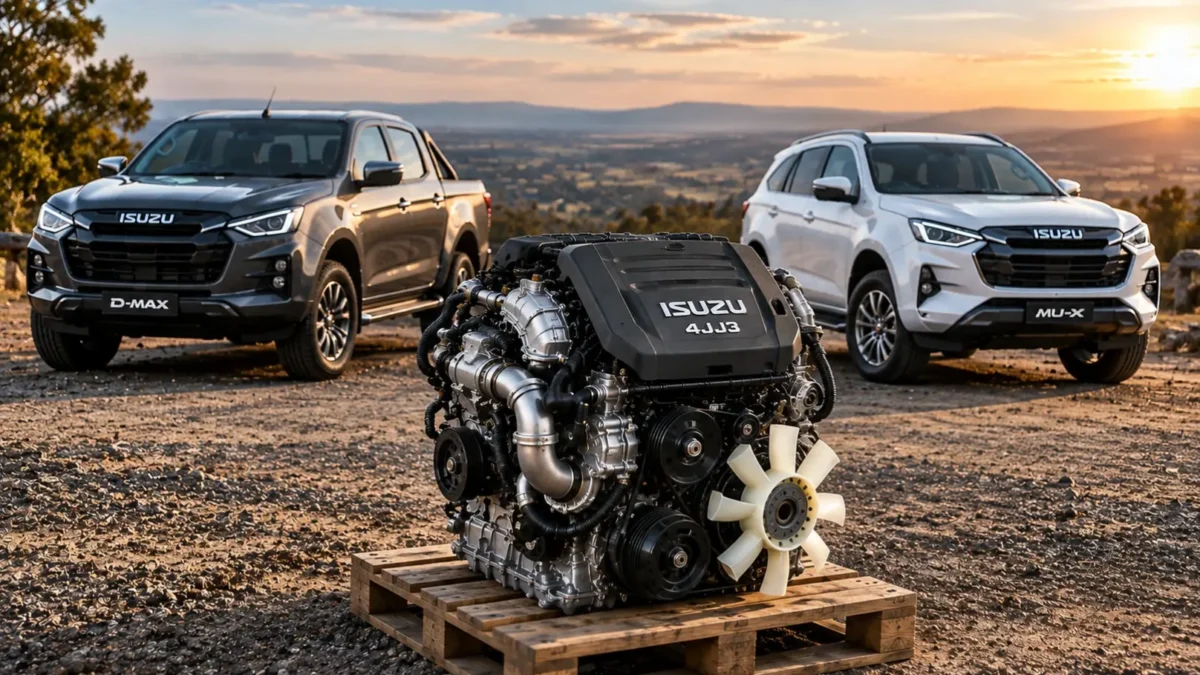
Table of Contents
- Isuzu 4JJ3 Engine at a Glance
- What Is the 4JJ3 Engine?
- The Most Common 4JJ3 Engine Problems
- 1. DPF regeneration problems
- 2. EGR carbon build-up
- 3. Variable geometry turbo (VGT) actuator sticking
- 4. Injector wear at higher kilometres
- 5. Overdue valve clearance checks
- 6. Cooling and ancillary wear
- What Causes Most 4JJ3 Problems?
- 4JJ3 Engine Oil and Oil Type
- Is the Isuzu 4JJ3 a Reliable Engine?
- 4JJ3 Engine Life Expectancy
- 4JJ3 Engine Upgrades: What’s Worth Doing
- 4JJ3 vs 4JJ1: Key Differences
- Buying a Used 4JJ3 or a 4JJ3 Engine for Sale
- What are the most common 4JJ3 engine problems?
- Is the Isuzu 4JJ3 a reliable engine?
- What are the 4JJ3 engine specs?
- How many cc is the 4JJ3 engine?
- What oil does the 4JJ3 engine use?
- How long will a 4JJ3 engine last?
- Which vehicles use the 4JJ3 engine?
The Isuzu 4JJ3 has earned a reputation as one of the toughest diesels in any Australian ute — and it mostly deserves it. But “tough” isn’t the same as “trouble-free.” Nearly every 4JJ3 engine problem owners report comes back to the emissions and air systems bolted to the engine, rather than the engine’s core internals.
That’s good news, because those faults are usually predictable, and most are preventable.
This guide covers the real 4JJ3 engine problems in the D-Max, MU-X and Mazda BT-50: what the symptoms look like, what causes them, and what fixing them involves. You’ll also find verified specs, the right oil, realistic life expectancy, and what to check before buying a used 4JJ3.
Quick answer: The most common 4JJ3 engine problems are DPF regeneration issues, EGR carbon build-up, variable geometry turbo (VGT) actuator sticking and injector wear at higher kilometres. Most are linked to driving patterns — especially frequent short trips — and servicing. The engine’s core mechanical internals have a strong reliability record.
Isuzu 4JJ3 Engine at a Glance
| Specification | Isuzu 4JJ3-TCX |
| Engine code | 4JJ3-TCX |
| Capacity | 2,999 cc (3.0 L) |
| Configuration | Inline four-cylinder turbo-diesel |
| Bore × stroke | 95.4 mm × 104.9 mm |
| Compression ratio | 16.3:1 |
| Fuel system | High-pressure common-rail direct injection |
| Turbocharger | Variable geometry (VGT), intercooled |
| Power | 140 kW @ 3,600 rpm |
| Torque | 450 Nm @ 1,600–2,600 rpm |
| Emissions equipment | EGR, DPF (Isuzu calls it a DPD) |
| Australian applications | Isuzu D-Max (2020 on), Isuzu MU-X (2021 on), Mazda BT-50 (2020 on) |
Figures are from Isuzu’s Australian specification data. Output is the same for manual and automatic versions — unusual in this class, where many utes lose torque in manual form.
What Is the 4JJ3 Engine?
The 4JJ3-TCX is Isuzu’s 3.0-litre turbo-diesel, launched in Australia with the new-generation D-Max in 2020. It replaced the long-running 4JJ1.
It’s often described as an evolution of the 4JJ1, and the bore and stroke are unchanged. But almost everything else is new: a new cylinder block, new pistons, a new cylinder head, a new fuel injection system, and a variable geometry turbocharger in place of the older setup.
The headline improvement isn’t the peak numbers — 10 kW and 20 Nm more than the 4JJ1 — it’s the spread. Peak torque now holds across a 1,000 rpm band, and around 400 Nm is available from roughly 1,400 to 3,250 rpm. That’s why the 4JJ3 feels relaxed towing and touring.
Important for anyone sourcing an engine: the 4JJ3 and 4JJ1 are not interchangeable, despite sharing a capacity and bore/stroke. Different block, head, injection and turbo. The same applies to the 1.9-litre RZ4E fitted to some D-Max variants — a completely different engine.
The Most Common 4JJ3 Engine Problems
Before the list, some useful context. Unlike certain rival diesels, the 4JJ3 hasn’t developed a reputation for catastrophic internal failures. The recurring issues cluster around emissions and airflow components — and those are heavily influenced by how the vehicle is driven.
1. DPF regeneration problems
This is the 4JJ3 engine problem owners run into most often.
The diesel particulate filter (DPF — Isuzu labels it DPD, for diesel particulate diffuser) traps soot from the exhaust, then periodically burns it off in a process called regeneration. For that to work, the exhaust needs to get hot and stay hot for a sustained period — which requires steady driving at speed.
Symptoms:
- DPD/DPF warning light
- Frequent or seemingly constant regeneration cycles
- Higher fuel consumption
- Reduced power, or limp mode in severe cases
- Idle speed sitting higher than normal during a regen
Cause: Most commonly, short trips and low-speed driving that never allow a regeneration to finish. Soot keeps accumulating faster than it’s burnt off. Towing at low speed and lots of idling make it worse.
What to check: Regeneration frequency is the key clue. If regens are happening unusually often even with regular highway driving, the DPF may not be the root cause. Faulty sensors — particularly the MAF sensor — and worn injectors can both prevent the exhaust reaching the temperature needed for a complete regen. Australian owners who’ve chased constant-regen problems have reported fixes from MAF sensor replacement and injector replacement.
The fix: A forced regeneration using a diagnostic tool clears most blockages. Severe cases need professional DPF cleaning or replacement. Prevention is simple: a sustained highway run regularly, rather than letting the vehicle live on short trips.
Severity: Moderate. Annoying and potentially expensive if ignored, but usually manageable.
2. EGR carbon build-up
Symptoms:
- Sluggish throttle response
- Rough idle
- Reduced power
- Check engine light
- Rising fuel consumption
Cause: The exhaust gas recirculation system feeds a portion of exhaust back into the intake to reduce emissions. That exhaust carries soot, which combines with oil vapour from the crankcase ventilation and slowly coats the EGR valve and intake with carbon. Short trips where the engine never fully warms up accelerate it.
What to check: EGR valve operation, intake condition, and fault codes. Carbon build-up often happens alongside DPF trouble, since both are driven by the same conditions.
The fix: EGR valve and intake cleaning. Some owners fit an oil catch can to reduce the oil vapour contributing to deposits — if you do, choose a quality unit and check it doesn’t affect your warranty position.
Severity: Moderate. A gradual problem rather than a sudden one, and routine cleaning keeps it under control.
A warning worth stating plainly: removing, disabling or “deleting” the EGR or DPF is generally illegal for road-registered vehicles in Australia, can void warranty, and can cause roadworthy and insurance problems. The legitimate fix is maintenance, not removal.
3. Variable geometry turbo (VGT) actuator sticking
Symptoms:
- Loss of boost and noticeably flat performance
- Check engine light — fault codes relating to turbo control
- Inconsistent power delivery
- Limp mode
Cause: The VGT uses movable vanes to adjust boost. Soot and carbon can cause those vanes, or the actuator controlling them, to stick. Vehicles that rarely see sustained load are more prone, since the vanes don’t get exercised through their full range.
What to check: Fault codes first. Actuator movement can be tested with diagnostic equipment. Don’t assume the turbo itself has failed — often the actuator or vanes are the issue, which is a smaller repair.
The fix: Cleaning the vane mechanism, or replacing and recalibrating the actuator. Full turbo replacement is only needed if the turbo itself is damaged.
Severity: Moderate. It can feel alarming because of the power loss, but it’s rarely engine-threatening.
4. Injector wear at higher kilometres
Symptoms:
- Rough idle
- Hard starting
- Smoke
- Increased fuel consumption
- Incomplete DPF regenerations
Cause: High-pressure common-rail injectors are precision components, and they wear over time. Fuel quality and fuel filter maintenance have a big influence on how long they last. Contaminated fuel is especially damaging.
What to check: Injector balance rates via diagnostic equipment, and fuel filter service history.
The fix: Injector replacement where required. Keeping fuel filters on schedule — and using reputable fuel suppliers — is the best prevention.
Severity: Moderate. Worn injectors also drive other problems on this list, particularly incomplete DPF regeneration, so it’s worth addressing rather than tolerating.
5. Overdue valve clearance checks
Symptoms: Increased engine noise, a ticking or tapping sound, and eventually reduced performance.
Cause: Valve clearances drift over time, and checks are easy to overlook — particularly on vehicles serviced outside the dealer network, or with incomplete service records.
What to check: Your service schedule and records. Ask specifically whether valve clearances have been checked at the intervals Isuzu specifies.
The fix: Inspection and adjustment. Straightforward when done on time.
Severity: Low if caught on schedule, higher if ignored for too long.
6. Cooling and ancillary wear
As with any engine, cooling system components, hoses and ancillaries wear over time. These are ordinary maintenance items rather than 4JJ3-specific design faults. Heavy towing in hot conditions is the biggest stress on the cooling system, so check coolant condition and look for leaks if your 4JJ3 does serious work.
What Causes Most 4JJ3 Problems?
A pattern runs through almost every fault above, and it’s worth spelling out.
The 4JJ3 is built for work — towing, touring, long distances. Its emissions systems are designed around that kind of use. Problems show up most often in vehicles used for the opposite: short suburban trips, school runs, and lots of idling, where the engine rarely reaches full temperature for long enough.
So if your 4JJ3 mostly does short runs, a regular sustained highway drive is the single most useful thing you can do for it. It helps the DPF regenerate fully, and reduces carbon in the EGR and turbo.
4JJ3 Engine Oil and Oil Type
Using the right oil matters more on a modern DPF-equipped diesel than on older engines. The wrong type can increase ash build-up in the DPF, which can’t be burnt off during regeneration.
- Viscosity: The factory fill is 5W-30, which Isuzu’s documentation associates with best performance and economy.
- Specification: Oils listed for this engine include heavy-duty diesel specifications such as API CK-4 and JASO DH-2, with low-ash ACEA C3 oils also referenced as suitable. The key requirement is compatibility with the DPF.
- Capacity: Commonly quoted at around 7.4 litres with a filter change — confirm against your owner’s manual, as it can vary by model and year.
- Service interval: Isuzu Australia specifies 15,000 km or 12 months for the new-generation D-Max under normal conditions.
If you tow heavily, work in dusty conditions, or do lots of short trips, consider changing the oil more frequently than the standard interval. Your owner’s manual is the final authority on grade and specification — check it before buying oil.
Is the Isuzu 4JJ3 a Reliable Engine?
Yes — it’s widely regarded as one of the most reliable diesels available in a new Australian 4WD.
A big part of that is design philosophy. The 4JJ3 avoids complex twin-turbo arrangements and a highly stressed tune. It makes 140 kW from 3.0 litres, which is conservative, and Isuzu’s light-truck engineering background shows in how it’s built.
What reliability depends on:
- Servicing on schedule with the correct oil
- Fuel filter changes and quality fuel
- Driving that allows regeneration — or deliberate highway runs if it doesn’t
- Attention to emissions components before small problems become large ones
4JJ3 Engine Life Expectancy
Honestly, it’s too early to give a definitive figure — and anyone who quotes you a precise number should be treated with caution.
The 4JJ3 only arrived in Australia in 2020, so the fleet hasn’t yet built up a large population of very high-kilometre examples. What we can say is that its predecessor, the 4JJ1, built a strong reputation for long service lives, and the 4JJ3’s conservative design gives good reason to expect similar durability.
In practice, a 4JJ3’s lifespan will be decided far more by maintenance and usage than by the engine design itself. A well-serviced engine used for towing and touring will almost certainly outlast a neglected one that lives on short trips.
4JJ3 Engine Upgrades: What’s Worth Doing
Owners commonly look at:
- ECU remapping — can improve power and torque, but check the warranty implications first. Many manufacturers treat unauthorised software changes as grounds to decline engine warranty claims.
- Oil catch cans — can help reduce oil vapour reaching the intake and EGR system.
- Snorkels — useful for dusty conditions and water crossings.
- Transmission and oil temperature monitoring — valuable for heavy towing.
What to avoid: DPF and EGR deletes. Beyond the legal issues in Australia, they can create warranty, insurance and resale problems that far outweigh any benefit.
4JJ3 vs 4JJ1: Key Differences
| 4JJ1 | 4JJ3 | |
| Capacity | 3.0 L | 3.0 L |
| Bore × stroke | Same | Same |
| Block, head, pistons | Earlier design | All new |
| Injection system | Earlier common-rail | New common-rail system |
| Turbo | Earlier setup | Variable geometry (VGT) |
| Power / torque | 130 kW / 430 Nm | 140 kW / 450 Nm |
| Australian use | D-Max and MU-X up to 2020 | D-Max, MU-X, BT-50 from 2020 |
| Interchangeable? | No | No |
Same capacity, same bore and stroke — but not the same engine. When buying parts or a replacement, match the engine code, not the displacement.
Buying a Used 4JJ3 or a 4JJ3 Engine for Sale
Whether you’re buying a used D-Max, MU-X or BT-50, or sourcing a replacement 4JJ3 engine, check:
- The engine code — confirm it’s a 4JJ3-TCX, not a 4JJ1 or RZ4E.
- Service history — oil, fuel filters and valve clearance checks.
- DPF behaviour — ask how often it regenerates, and look for warning lights.
- Usage history — towing, touring, or mostly short trips.
- Signs of modification — remaps and especially emissions deletes.
- Fault codes — a scan before purchase is cheap insurance.
- Testing and kilometres — for a replacement engine, ask how it was tested and how the kilometres were verified.
- Warranty terms in writing — including labour, exclusions and freight.
- What’s included — sensors, turbo, injectors and emissions components vary between listings.
- VIN-based fitment — confirm compatibility with your specific vehicle, not just the model name.
If you’re looking for a replacement 4JJ3 engine, send us your VIN and vehicle details and we’ll confirm the right engine for your D-Max, MU-X or BT-50, along with warranty terms in writing.
What are the most common 4JJ3 engine problems?
DPF regeneration issues, EGR carbon build-up, variable geometry turbo actuator sticking, and injector wear at higher kilometres. Most are linked to driving patterns — particularly frequent short trips — and servicing. The engine’s core internals have a strong reliability record.
Is the Isuzu 4JJ3 a reliable engine?
Yes. It’s widely regarded as one of the most reliable diesels in a new Australian 4WD. Its conservative tune and relatively simple design help, but reliability still depends on correct servicing and driving that allows the DPF to regenerate properly.
What are the 4JJ3 engine specs?
The 4JJ3-TCX is a 2,999 cc inline four-cylinder turbo-diesel with a bore and stroke of 95.4 × 104.9 mm and a 16.3:1 compression ratio. It produces 140 kW at 3,600 rpm and 450 Nm from 1,600 to 2,600 rpm, with common-rail injection and a variable geometry turbo.
How many cc is the 4JJ3 engine?
The 4JJ3 displaces 2,999 cc, marketed as 3.0 litres. It shares its capacity, bore and stroke with the earlier 4JJ1, but uses a new block, head, pistons, injection system and turbocharger.
What oil does the 4JJ3 engine use?
The factory fill is 5W-30. Suitable oils include heavy-duty diesel specifications such as API CK-4, with low-ash ACEA C3 oils also referenced. It must be compatible with the DPF. Capacity is commonly quoted around 7.4 litres with a filter — confirm with your owner’s manual.
How long will a 4JJ3 engine last?
There isn’t yet a definitive figure, since the engine only arrived in Australia in 2020. Its predecessor built a strong reputation for longevity, and the 4JJ3’s conservative design supports similar expectations. Real-world lifespan will depend mostly on servicing and how the vehicle is used.
Which vehicles use the 4JJ3 engine?
In Australia, the Isuzu D-Max from 2020, the Isuzu MU-X from 2021, and the Mazda BT-50 from 2020. Some D-Max variants use the 1.9-litre RZ4E instead, which is a completely different engine.

Looking for this part?
Send one enquiry and reach Australian suppliers who handle your vehicle.
Request a quote