The Toyota Water Engine: Separating Myth From Real Hydrogen Technology
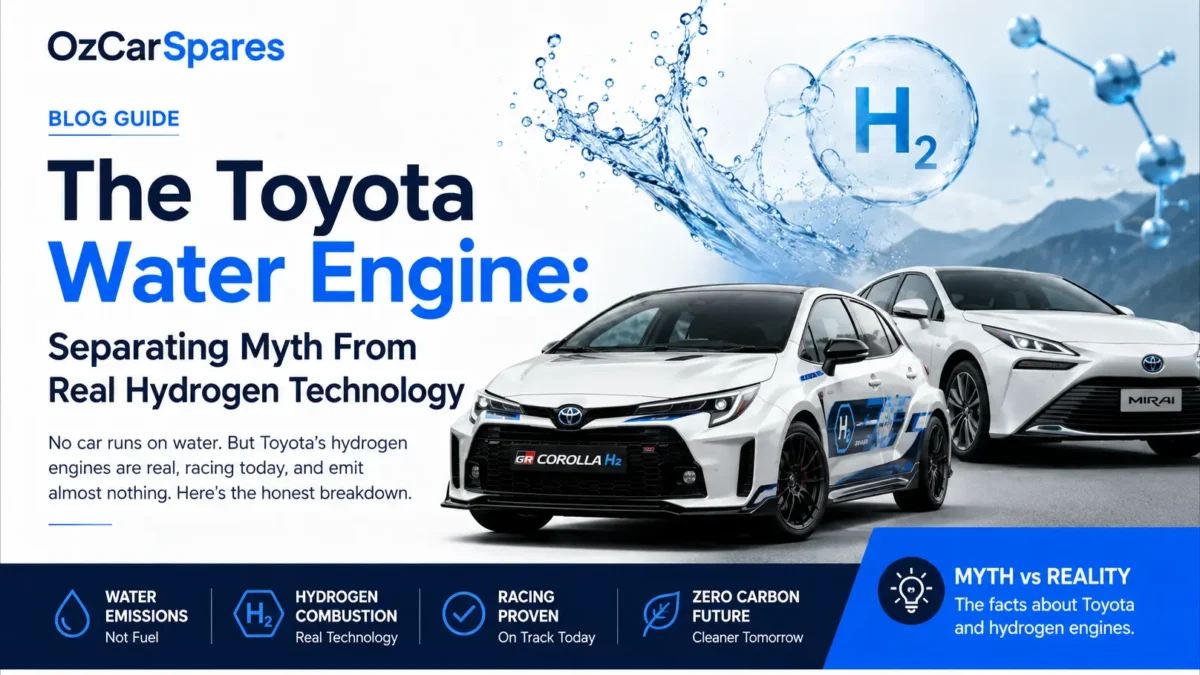
Table of Contents
- Why a Water-Powered Engine Can’t Work
- What Toyota Actually Built: Two Different Hydrogen Technologies
- Toyota’s Hydrogen Fuel Cell: The Mirai
- Toyota’s Hydrogen Combustion Engine: The Interesting One
- The 2026 world first
- The boil-off problem
- Is Hydrogen Combustion Actually Zero-Emission?
- Will You Be Able to Buy a Hydrogen Toyota?
- What This Means for Your Toyota Today
- Myths Worth Retiring
- Is there a Toyota water engine?
- Can a car run on water?
- What is Toyota’s hydrogen combustion engine?
- How is the Mirai different from a hydrogen combustion engine?
- Are Toyota’s hydrogen engines truly zero-emission?
- Do HHO or water fuel kits work?
- When will hydrogen Toyotas be widely available?
Search for a Toyota water engine and you’ll find plenty of videos promising a car that runs on tap water. It’s an appealing idea. It’s also not real — not from Toyota, not from anyone, and not because of a conspiracy. It comes down to physics.
What is real is arguably more interesting. Toyota has spent years developing hydrogen engines that produce water as their main emission rather than running on it. Those engines exist, they’re racing right now, and one of them set a world first in mid-2026. Here’s the honest version of both stories.
Quick answer: There is no Toyota water engine, and no car can run on water. Water is already a burnt fuel — splitting it back into hydrogen takes more energy than you get out. The confusion comes from Toyota’s real hydrogen vehicles, which emit water vapour from the tailpipe.
Why a Water-Powered Engine Can’t Work
This isn’t Toyota holding something back. It’s a hard limit.
Water is H₂O — hydrogen that has already combined with oxygen. In energy terms, water is what’s left over after hydrogen burns. It’s ash. Trying to run an engine on water is like trying to fuel a fire with the smoke it already produced.
You can split water back into hydrogen and oxygen through electrolysis, and that hydrogen will burn. But the process always consumes more energy than the resulting hydrogen releases. Some energy is always lost as heat — that’s the second law of thermodynamics, and no engineering breakthrough gets around it.
Where the “water engine” claims come from:
- Old free-energy scams. Various inventors have claimed water-fuelled cars since the 1970s. Several were prosecuted for fraud.
- HHO or “Brown’s gas” kits. These use the car’s own alternator to split water. They consume more fuel to run than they save.
- Misread hydrogen news. Toyota’s hydrogen cars emit water. Headlines get compressed, and “emits only water” becomes “runs on water.”
- Viral video clips. Engagement rewards astonishing claims, so they spread faster than corrections.
If a water-powered engine worked, it would be the single biggest discovery in the history of energy. It wouldn’t be a YouTube exclusive.
What Toyota Actually Built: Two Different Hydrogen Technologies
Here’s where genuine confusion is understandable, because Toyota runs two completely separate hydrogen systems, and they work in different ways.
| Hydrogen Fuel Cell | Hydrogen Combustion Engine | |
|---|---|---|
| Example | Toyota Mirai | GR Corolla H2 |
| How it works | Chemical reaction generates electricity | Burns hydrogen in a piston engine |
| Drives the wheels via | Electric motor | Conventional engine and gearbox |
| Main emission | Water only | Water vapour, trace NOx |
| Sound and feel | Silent, like an EV | Sounds and behaves like a petrol engine |
| Status | On sale (limited markets) | Racing and in development |
Both are zero-carbon at the tailpipe. Neither runs on water.
Toyota’s Hydrogen Fuel Cell: The Mirai
The Mirai is the one most people have heard of. It isn’t a combustion car at all — it’s what Toyota calls a “plug-less” electric vehicle. Hydrogen from the tank meets oxygen from the air inside a fuel cell stack, generating electricity that drives an electric motor. The only tailpipe output is water.
The current model produces around 182 hp with an estimated range of roughly 640 km on a fill, and refuelling takes minutes rather than hours.
The catch is infrastructure. Hydrogen stations remain scarce almost everywhere, which has kept sales tiny — only a few hundred units in some recent reporting periods. In Australia, refuelling options are extremely limited and concentrated around a handful of trial sites, which is why you won’t see many on the road here.
Toyota’s Hydrogen Combustion Engine: The Interesting One
This is the technology that matters most if you care about engines. Instead of generating electricity, Toyota takes a conventional turbocharged petrol engine and modifies it to burn hydrogen directly. It keeps the pistons, the gearbox, the noise and the character — while cutting carbon emissions at the tailpipe to essentially nothing.
Toyota has been proving it the hard way, in endurance racing:
- GR Corolla H2 — the main development car, competing in Japan’s Super Taikyu endurance series
- GR Yaris H2 — ran at a World Rally Championship event in 2022
- GR H2 Racing Concept — a Le Mans-focused prototype revealed in 2023
The programme moved from compressed hydrogen gas to liquid hydrogen, which packs far more fuel into the same tank space and therefore extends range significantly.
The 2026 world first
At the Fuji 24 Hours in June 2026, Toyota’s liquid hydrogen GR Corolla became the world’s first race car to compete with a superconducting liquid hydrogen pump. That sounds obscure, but it addresses the exact problem that had been holding the programme back — pump durability under sustained maximum output.
Earlier in the programme, Toyota had already demonstrated hydrogen combustion switching technology and completed a 24-hour race without replacing the fuel pump, a meaningful durability milestone.
The boil-off problem
Liquid hydrogen has to be kept extremely cold. Heat inevitably seeps in, so some fuel evaporates — “boil-off” — and historically that vapour was simply vented to the atmosphere. Toyota has demonstrated systems that capture and reuse boil-off gas rather than wasting it, feeding it back to either the engine or a fuel cell. Solving this is one of the practical hurdles between racing prototypes and a production car.
Is Hydrogen Combustion Actually Zero-Emission?
Close, but the honest answer needs a caveat, and this is where a lot of coverage oversells it.
- Carbon dioxide: essentially none at the tailpipe. There’s no carbon in hydrogen, so there’s nothing to produce CO₂.
- Nitrogen oxides (NOx): because hydrogen burns in ordinary air at high temperature, small amounts of NOx can form. This is a genuine engineering challenge, not a marketing footnote.
- Trace emissions: tiny amounts from engine oil burning, as with any combustion engine.
There’s also the bigger question of where the hydrogen comes from. Hydrogen made using renewable electricity (“green hydrogen”) is genuinely low-carbon. Hydrogen made from natural gas (“grey hydrogen”) produces significant emissions during production, even if the car itself is clean. The fuel’s footprint depends heavily on its source.
Will You Be Able to Buy a Hydrogen Toyota?
Not a hydrogen combustion model in the near term. Here’s a realistic picture:
- Available now: The Mirai fuel cell sedan, in select markets with hydrogen infrastructure.
- In development: Hydrogen combustion engines, currently proven through racing.
- Main obstacles: Refuelling infrastructure, hydrogen production cost, liquid hydrogen storage, and boil-off management.
- Toyota’s position: The company describes a “multi-pathway” strategy — hybrids, EVs, and hydrogen developed in parallel rather than betting on one.
For Australian drivers specifically, hydrogen remains a long way off as a practical option. Refuelling infrastructure is the binding constraint, not the technology.
What This Means for Your Toyota Today
If you own or are buying a Toyota, none of this changes anything in the short term. Petrol, diesel and hybrid engines will be serviced, repaired and replaced the same way for many years yet — hydrogen is a parallel development, not a replacement schedule.
The practical takeaway: don’t let speculation about future fuels influence a decision about an engine you need now. If you’re weighing up a replacement engine, the proven petrol, diesel and hybrid units are what matter. Our guide to the most reliable Toyota engines covers which ones genuinely go the distance.
(Link the words “most reliable Toyota engines” above to: /best-toyota-engine/)
Myths Worth Retiring
- “Toyota built a car that runs on water.” No. Water is a combustion product, not a fuel.
- “A water fuel kit will improve your economy.” HHO kits draw power from your alternator, costing more fuel than they save.
- “Hydrogen cars are just EVs in disguise.” Fuel cell cars are electric; hydrogen combustion cars are genuinely piston engines.
- “Hydrogen is completely emission-free.” Zero carbon at the tailpipe, but NOx and the fuel’s production method both matter.
- “Big oil is suppressing water engines.” The barrier is thermodynamics, and it applies identically to every manufacturer on earth.
Is there a Toyota water engine?
No. Toyota has never built an engine that runs on water, and no manufacturer has. Water is already a combustion product — splitting it back into hydrogen consumes more energy than burning that hydrogen releases. The myth comes from Toyota’s hydrogen vehicles, which emit water vapour.
Can a car run on water?
No. It would violate the second law of thermodynamics. Water can be split into hydrogen and oxygen through electrolysis, but that always takes more energy than the hydrogen returns, so the vehicle would need an external power source larger than the fuel it produced.
What is Toyota’s hydrogen combustion engine?
It’s a conventional piston engine modified to burn hydrogen instead of petrol. It keeps the feel, sound and mechanical layout of a normal engine while producing essentially no carbon dioxide. Toyota develops it through endurance racing with the GR Corolla H2.
How is the Mirai different from a hydrogen combustion engine?
The Mirai uses a fuel cell: hydrogen and oxygen react to generate electricity, which drives an electric motor. There’s no combustion and it’s silent. A hydrogen combustion engine actually burns the fuel in cylinders and behaves like a petrol engine.
Are Toyota’s hydrogen engines truly zero-emission?
They emit no carbon dioxide at the tailpipe, but hydrogen burned in air can produce small amounts of nitrogen oxides. The overall footprint also depends on whether the hydrogen was made with renewable energy or from natural gas.
Do HHO or water fuel kits work?
No. These kits use the vehicle’s alternator to split water, which increases engine load and consumes more fuel than the small amount of hydrogen produced can offset. There’s no credible evidence of efficiency gains.
When will hydrogen Toyotas be widely available?
The Mirai fuel cell is already sold in markets with hydrogen infrastructure, though volumes are small. Hydrogen combustion engines remain in development and racing. Infrastructure, not engine technology, is the main obstacle — especially in Australia.

Looking for this part?
Send one enquiry and reach Australian suppliers who handle your vehicle.
Request a quote