Toyota 86 Engines by Year: Codes, Sizes & Changes
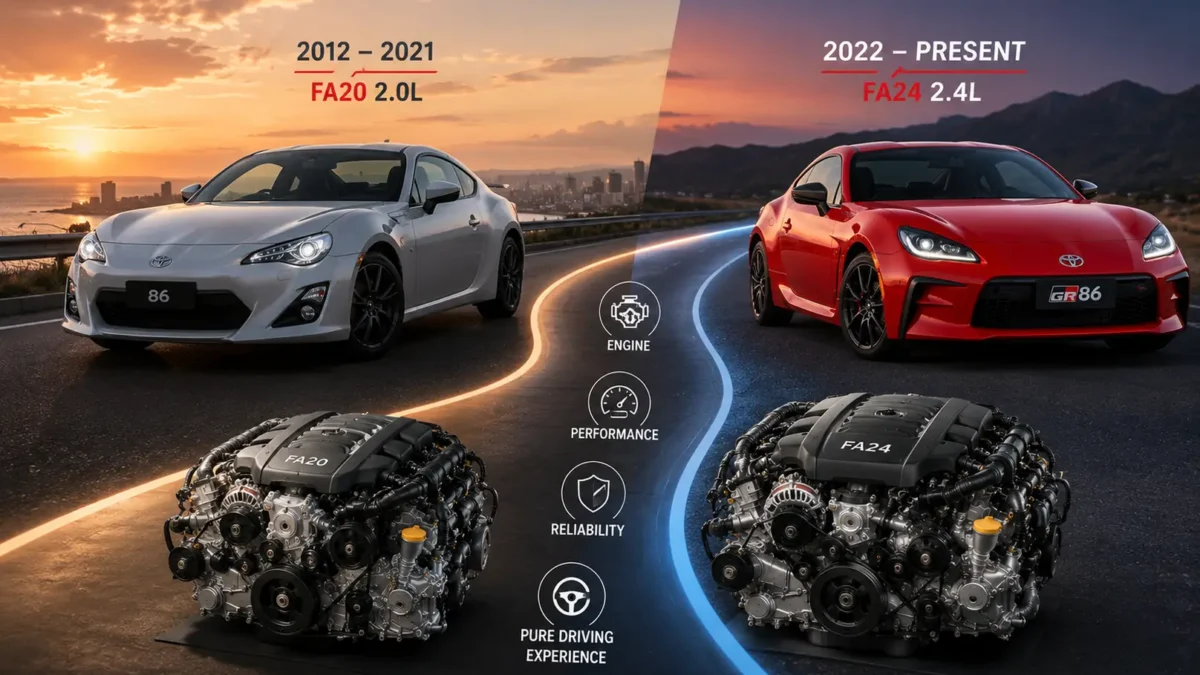
Table of Contents
- Toyota 86 Engine Overview
- Toyota 86 Engines by Year
- 2012 Toyota 86 engine
- 2013–2016 Toyota 86 engine: no changes
- 2017–2021 Toyota 86 engine: the facelift bump
- 2022 onwards: Toyota GR86 engine (FA24)
- First-Generation Toyota 86 Engine – FA20
- Second-Generation Toyota GR86 Engine – FA24
- Toyota 86 FA20 vs GR86 FA24
- Are Toyota 86 Engines Interchangeable Between Years?
- How to Identify the Correct Toyota 86 Replacement Engine
- Buying a Used Toyota 86 Engine
- What engine does a Toyota 86 have?
- What engine is in a 2012 Toyota 86?
- What engine is in a 2017 Toyota 86?
- What is the Toyota 86 engine code?
- Is the Toyota 86 engine the same as the Subaru BRZ engine?
- Is the FA24 better than the FA20?
- Can an FA24 replace an FA20?
There are only two Toyota 86 engine options ever fitted to Australian-delivered cars: the 2.0-litre FA20 boxer four that powered every 86 from its June 2012 launch through to 2021, and the 2.4-litre FA24 that replaced it when the car became the GR86 in September 2022. Both are naturally aspirated, Subaru-built flat-fours co-developed with Toyota — but they’re not the same engine, and even within the FA20’s near-decade run there are genuine differences between an early 2012 car and a later, facelifted one. Here’s what’s fitted to every model year, and what actually changed.
Toyota 86 Engine Overview
Two generations, two engine families, and — for the first generation — a mid-life power increase that only applied to manual cars. That’s the outline. The table below fills in the numbers.
| Model Years | Generation | Engine Code | Engine Size | Fuel | Configuration | Power | Notes |
|---|---|---|---|---|---|---|---|
| 2012–2016 (pre-facelift) | 1st gen (ZN6) | FA20 | 2.0L (1,998cc) | 98 RON Premium ULP | Flat-4 boxer, NA | 147kW @ 7,000rpm / 205Nm @ 6,400–6,600rpm | Same output for manual and auto |
| 2017–2021 (facelift, manual) | 1st gen (ZN6) | FA20 | 2.0L (1,998cc) | 98 RON Premium ULP | Flat-4 boxer, NA | 152kW @ 7,000rpm / 212Nm @ 6,400–6,600rpm | New intake manifold, revised ECU map, shorter final drive |
| 2017–2021 (facelift, auto) | 1st gen (ZN6) | FA20 | 2.0L (1,998cc) | 98 RON Premium ULP | Flat-4 boxer, NA | 147kW @ 7,000rpm / 205Nm @ 6,400–6,600rpm | Carried over the pre-facelift intake and tune |
| 2022–present | 2nd gen GR86 (ZN8) | FA24 | 2.4L (2,387cc) | 98 RON Premium ULP | Flat-4 boxer, NA | 174kW @ 7,000rpm / 250Nm @ 3,700rpm | New block, larger bore, same output for manual and auto |
Two things worth flagging early. Toyota Australia has only ever sold this car as the “86” and, from September 2022, the “GR86” — you won’t find a “GT86” badge locally, though that’s the same engine platform sold under that name in Europe. And the 2017 power bump only applied to manual cars; automatics kept the original 147kW/205Nm tune to the end of first-generation production.
Toyota 86 Engines by Year
2012 Toyota 86 engine
The Toyota 86 went on sale in Australia on 18 June 2012, in GT and GTS grades, with a six-speed manual standard and a six-speed automatic as a $2,500 option on both. Every 2012 86 (chassis code ZN6) ran the FA20, producing 147kW at 7,000rpm and 205Nm at 6,400–6,600rpm, regardless of transmission. It’s a 2.0-litre naturally aspirated flat-four with Toyota’s D-4S dual injection system, and it needs 98 RON premium unleaded to hit those figures.
2013–2016 Toyota 86 engine: no changes
The 2013 Toyota 86 engine, the 2014 Toyota 86 engine, and the 2015 and 2016 cars all carried the identical FA20 tune as the 2012 launch car — same 147kW/205Nm output, same compression ratio, same fuel system. Toyota made trim and equipment updates across this run, but none touched the engine itself. Chasing a replacement engine for an 86 built anywhere in this five-year window? Any FA20 from another 2012–2016 car is a genuinely close match, provided the transmission type lines up.
2017–2021 Toyota 86 engine: the facelift bump
Toyota facelifted the 86 for the Japanese market in mid-2016, and Australian cars followed in November 2016 as MY17 stock. Manual variants got a genuine mechanical update: a new cast-alloy intake manifold (earlier cars used plastic), reworked valve stems, a revised ECU map, and a shorter 4.30:1 final drive in place of 4.10:1. The result was 152kW at 7,000rpm and 212Nm at 6,400–6,600rpm — a real bump, not a cosmetic one.
Automatic variants didn’t get any of it, keeping the plastic intake, original ECU tune and 147kW/205Nm output to the end of production. So a 2017 manual and a 2017 automatic are running physically different engines under the same model year — worth knowing when matching a replacement.
That facelifted spec then carried through unchanged for 2018, 2019, 2020 and 2021. Toyota didn’t touch the powertrain again after November 2016, so the 2021 Toyota 86 engine is still the facelifted FA20 — 152kW manual, 147kW auto. Worth clearing up some confusion here: Toyota and Subaru revealed the next-generation 86/BRZ globally in 2021, leading some buyers to assume “2021 Toyota 86” means the new car. It doesn’t — that second-generation model didn’t go on sale in Australia until September 2022, badged GR86. Any 86 registered new here in 2021 is still the first-generation, FA20-powered car.
2022 onwards: Toyota GR86 engine (FA24)
The GR86 landed in Australian showrooms in September 2022, and with it came a genuinely new engine rather than a reworked FA20. The FA24 produces 174kW at 7,000rpm and 250Nm at 3,700rpm — and unlike the outgoing FA20, both manual and automatic GR86s get the same output. Toyota badges the car “GR86” now, not “86”, though plenty of buyers still search under the old name. That spec has carried through unchanged into the current 2025 Toyota 86 (GR86) lineup, with no year-on-year power creep since launch.
First-Generation Toyota 86 Engine – FA20
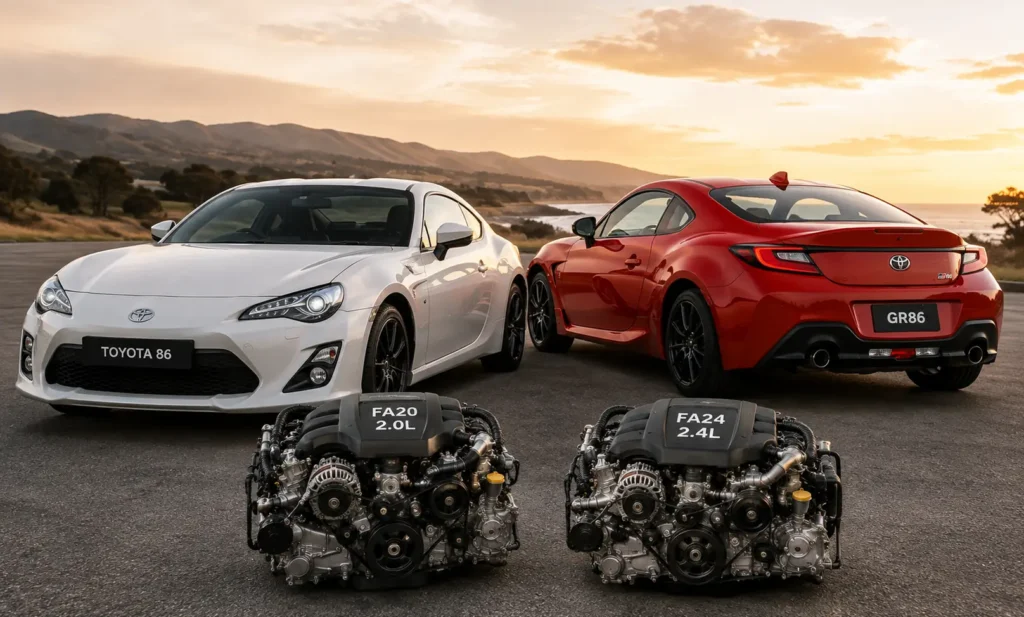
The FA20 is a 2.0-litre horizontally opposed four-cylinder — a “boxer” engine, where pistons move outward from the crank in pairs rather than up and down, giving the 86 a low centre of gravity for its size. It’s a genuinely square design, with an 86mm bore and 86mm stroke (part of why Toyota chose the “86” name), and a 12.5:1 compression ratio.
Subaru designed and built the engine at its Gunma plant in Japan, in partnership with Toyota — hence two codes floating around: Subaru’s FA20D, and Toyota’s own 4U-GSE. Among mechanics and in the aftermarket, it’s almost always just called the FA20, and that’s the code worth quoting when sourcing parts or a replacement engine.
The standout technical feature is D-4S, Toyota’s dual injection system combining direct injection (sprayed straight into the combustion chamber, good for throttle response and efficiency) with conventional port injection (better for cold starts and clean combustion at lower loads). It’s a meaningful part of how the FA20 makes its power without forced induction, not just a badge.
In Australian trim, that’s 147kW/205Nm from launch through to October 2016, and 152kW/212Nm for manual cars from the November 2016 facelift onward (automatics stayed at 147kW/205Nm). Both eras run a six-speed manual or six-speed automatic, sending power to the rear wheels only.
Second-Generation Toyota GR86 Engine – FA24
The FA24 is Subaru and Toyota’s follow-up to the FA20, and it’s a genuinely different engine rather than a bored-out version of the old one. Displacement grows to 2.4 litres (2,387cc), and the bore/stroke relationship changes to 94mm x 86mm — oversquare, compared with the FA20’s perfectly square dimensions. It uses a different block, revised internals and an updated induction system, though it retains the D-4S direct-and-port injection approach.
The performance difference isn’t just the headline power figure. Peak torque arrives at 3,700rpm on the FA24, versus roughly 6,400rpm on the FA20 — a flatter, more usable spread that needs less work from the driver to access decent acceleration. Combined with the 174kW peak, that’s a meaningfully more flexible engine day-to-day, not just a faster one on paper.
Because of that, the FA20 and FA24 shouldn’t be treated as direct replacements for each other. Different displacement, different physical dimensions, different ECU and wiring — swapping one for the other is a proper conversion project involving mounts, loom, ECU and likely transmission considerations, not a straightforward drop-in.
Toyota 86 FA20 vs GR86 FA24
| Spec | FA20 | FA24 |
|---|---|---|
| Engine code | FA20 (Subaru FA20D / Toyota 4U-GSE) | FA24 (Subaru FA24D) |
| Displacement | 2.0L (1,998cc) | 2.4L (2,387cc) |
| Bore x stroke | 86mm x 86mm | 94mm x 86mm |
| Compression ratio | 12.5:1 | 12.5:1 |
| Power (AU) | 147kW auto; 152kW manual (2017–21) | 174kW manual and auto |
| Torque (AU) | 205Nm auto; 212Nm manual (2017–21) | 250Nm manual and auto |
| Torque peak | ~6,400–6,600rpm | 3,700rpm |
| Fuel system | D-4S direct + port injection | D-4S direct + port injection (revised) |
| Generation | 1st gen Toyota 86 (ZN6) | 2nd gen Toyota GR86 (ZN8) |
| AU model years | 2012–2022 | 2022–present |
| Key differences | Square bore/stroke, higher-revving character, narrower torque band | Larger oversquare bore, flatter torque curve, not FA20-compatible |
Are Toyota 86 Engines Interchangeable Between Years?
Mostly yes within the FA20 family — but “it’s a Toyota 86 engine” isn’t enough information on its own to guarantee a bolt-in fit. A handful of things actually matter:
- Engine code. FA20 and FA24 aren’t interchangeable without a full conversion. Match code to code.
- Pre-facelift vs facelift (FA20 only). A 2012–2016 engine and a 2017–2021 manual engine differ in intake manifold, ECU tune and final drive gearing. They’ll generally still run, but it’s not a true like-for-like match.
- Manual vs automatic. Even within the same model year, manual and automatic FA20s carry different ECU maps and, post-facelift, a different intake manifold, plus different flywheel/flexplate and clutch or torque converter components.
- ECU and wiring. The ECU needs to match the donor engine’s tune and transmission pairing. Loom connectors and pinouts can vary between model years, particularly around the facelift changeover.
- Sensors. Oxygen, knock, crank and cam sensors are generally consistent within a generation, but check against the year you’re sourcing from.
- Intake and exhaust differences. The facelift’s cast intake manifold on manual cars is a physical, not just electronic, difference from earlier and automatic engines.
- Transmission compatibility. Bell housing patterns are shared across the FA20 range, but engine and gearbox should still be sourced as a matched pair where possible.
- Emissions equipment. ADR-compliant exhaust and catalytic setups can differ from JDM-import donor vehicles — worth checking if the engine came out of an imported car.
- Ancillary components. Alternator brackets, air-con mounts and other bolt-ons can vary slightly by build date.
The safe approach is to match engine code first, transmission type second, and model year (pre- or post-facelift) third — then confirm against the actual vehicle details rather than assuming “same model, same badge” is close enough.
How to Identify the Correct Toyota 86 Replacement Engine
The most reliable way to identify the right engine for your car is to work from your own vehicle’s details rather than the model year on your rego papers alone.
- VIN. Your 17-digit VIN and compliance plate record engine and build details specific to your car — far more precise than saying “I’ve got a 2017 86.”
- Build date. The facelift landed partway through a calendar year (November 2016), so a car registered in early 2017 could have been built either side of that changeover. The compliance plate build date settles it; the rego year alone doesn’t.
- Engine code. Stamped on the block, and the fastest way to compare apples with apples against a donor engine.
- Model year. A useful starting point, but treat it as a guide rather than a guarantee around the November 2016 changeover.
- Transmission. Confirm manual or automatic, since the two aren’t running identical specs on facelifted cars.
- Vehicle details generally. Grade, compliance status, and whether the car was delivered new here or privately imported can all affect what’s actually fitted.
If in doubt, send your VIN to the seller and ask them to confirm engine code, build date and transmission against their donor vehicle before committing to anything.
Buying a Used Toyota 86 Engine
A used FA20 or FA24 can be excellent value if you know what to check first.
Kilometres. Both engines hold up reasonably well when they haven’t been thrashed or heavily modified. There’s no single “safe” number — ask for the actual odometer reading rather than a rough estimate.
Compression or leak-down testing. Where the seller can arrange it, this gives a genuine read on ring and valve health, particularly on a higher-kilometre engine.
Service history. Neither engine uses a timing belt — both run timing chains, so there’s no scheduled belt interval to worry about. Regular oil changes still matter, so ask what history is available.
Oil leaks. Check around the rear main seal and head gasket area for weeping or consumption, particularly on any engine that’s spent time on a track.
Overheating history. Ask directly whether the donor vehicle had cooling system issues or head gasket work. A straight answer tells you a lot.
Engine noise. Any documented cold-start rattle, knock or excessive valve-train tick should be disclosed before purchase, not discovered after fitment.
Warranty. Reputable sellers will offer some warranty period on the engine — confirm what’s covered (block and internals, or ancillaries too) before buying.
What’s included. A “long block” is just the core engine; a complete engine might include the loom, ECU and manifolds. Know exactly what you’re getting.
Freight and delivery. Engines are heavy, palletised freight — ask about timeframes and whether it’s kerbside or full delivery, especially interstate.
Confirming compatibility. Tie all of this back to the VIN and engine code checks above — confirm fitment before paying a deposit, not after the engine arrives.
What engine does a Toyota 86 have?
First-generation Toyota 86s (2012–2021) run the 2.0-litre FA20 boxer four. The second-generation car, badged GR86 from September 2022, runs the larger 2.4-litre FA24.
What engine is in a 2012 Toyota 86?
The FA20, producing 147kW at 7,000rpm and 205Nm at 6,400–6,600rpm, the same output on manual and automatic.
What engine is in a 2017 Toyota 86?
Still the FA20, but this is the first facelifted year. Manual cars produce 152kW/212Nm; automatics remained at 147kW/205Nm.
What is the Toyota 86 engine code?
FA20 for the first generation (also referred to as Subaru’s FA20D, or Toyota’s own code 4U-GSE) and FA24 for the GR86.
Is the Toyota 86 engine the same as the Subaru BRZ engine?
Yes — the 86 and BRZ share the same FA20 (and later FA24) engine family, jointly developed by Toyota and Subaru and built at Subaru’s Gunma plant. Minor ECU tuning and ancillary differences can still exist between the two badges, so match by engine code and build details rather than assuming a straight swap.
Is the FA24 better than the FA20?
It makes more power and considerably more torque, arriving much lower in the rev range, which makes the GR86 noticeably easier to drive quickly without working the engine as hard. It’s a larger, revised engine rather than an upgraded FA20.
Can an FA24 replace an FA20?
Not as a straightforward swap. Different displacement, different physical dimensions, different ECU and wiring, and likely different transmission pairing considerations mean it’s a full conversion project rather than a like-for-like replacement.

Looking for this part?
Send one enquiry and reach Australian suppliers who handle your vehicle.
Request a quote