Toyota Engine Oil: Types, Grades and Capacities Explained
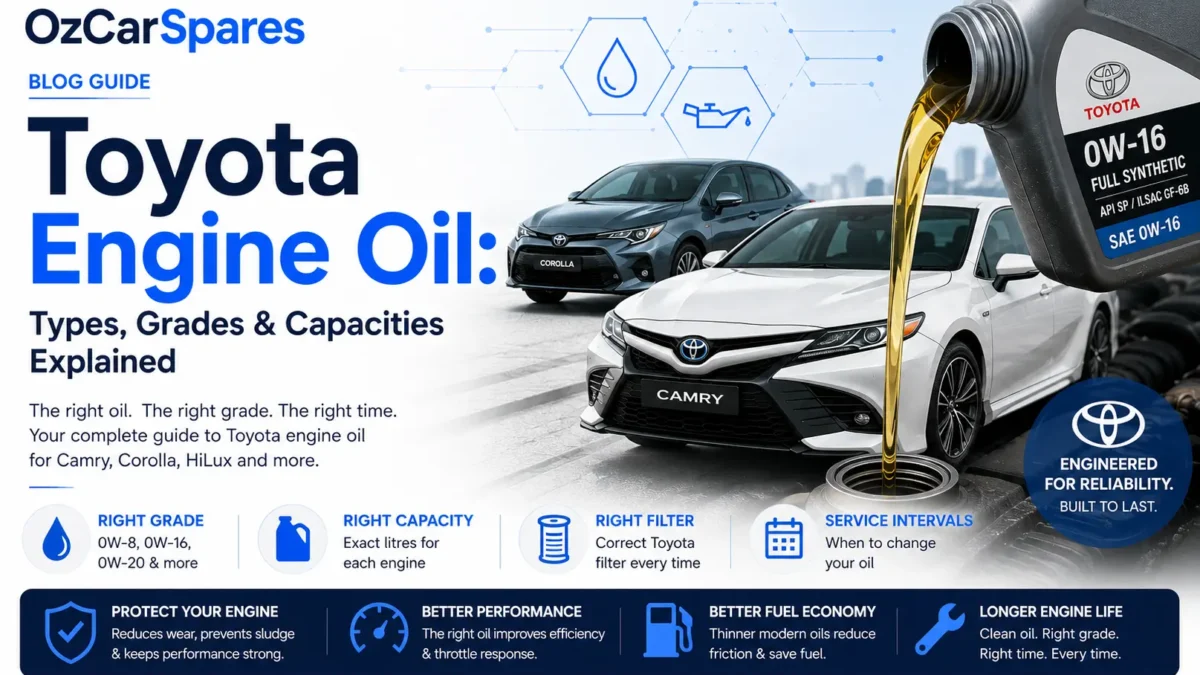
Table of Contents
- Toyota Camry Engine Oil by Year
- Toyota Corolla Engine Oil by Year
- Understanding Toyota Oil Grades
- Hybrid vs. Petrol: Does It Matter?
- Toyota Engine Oil Filters
- How Often Should You Change Toyota Engine Oil?
- Common Oil Mistakes on Toyotas
- Looking for an Engine, Not Just the Oil?
- What engine oil does a Toyota Camry take?
- How much oil does a Toyota Camry need?
- What oil does a Toyota Corolla use?
- Can I use 0W-20 instead of 0W-16?
- Does Toyota require full synthetic oil?
- How often should I change my Toyota’s engine oil?
- What oil filter does my Toyota need?
- What oil do Toyota diesel engines use?
Putting the wrong oil in a modern Toyota isn’t a small mistake. Today’s engines run remarkably thin oils — some as light as 0W-8 — because their variable valve timing and oil pumps are built around that exact viscosity. Go heavier “to be safe” and you can actually cost yourself fuel economy and slow the systems that depend on oil pressure.
This guide covers the correct engine oil for the most common Toyotas in Australia, including Camry and Corolla, with grades, capacities in litres, filter part numbers and change intervals. Your owner’s manual is always the final word, but this will get you the right answer fast.
Quick answer: Most Toyota Camry models from 2018 onward use 0W-16 full synthetic, with a capacity around 4.5 litres including the filter. Older Camrys (2012–2017) use 0W-20, and the current hybrid-only Camry uses ultra-thin 0W-8. Corollas use 0W-16 or 0W-20 depending on engine and year.
Toyota Camry Engine Oil by Year
Toyota has moved steadily to thinner, more efficient synthetic oils across Camry generations. Here’s the breakdown.
| Camry years | Engine | Oil grade | Capacity (with filter) |
|---|---|---|---|
| 2025–2026 (hybrid only) | 2.5L hybrid | 0W-8 full synthetic | ~4.2 L |
| 2018–2024 | 2.5L 4-cyl (A25A-FKS) | 0W-16 full synthetic | ~4.5 L |
| 2018–2024 | 3.5L V6 (2GR-FKS) | 0W-20 full synthetic | ~5.4 L |
| 2018–2024 | 2.5L hybrid (A25A-FXS) | 0W-16 full synthetic | ~4.2 L |
| 2012–2017 | 2.5L / 3.5L | 0W-20 full synthetic | ~4.4–5.7 L |
| 2002–2011 | 2.4L / 3.0–3.5L | 5W-30 | ~4.3–5.7 L |
Capacities are approximate and include a filter change — always confirm the final level on the dipstick.
On the newest Camry: the 2025–2026 hybrid specifies SAE 0W-8. If you can’t find 0W-8, 0W-16 is acceptable as a temporary fill, but switch back at the next service.
Toyota Corolla Engine Oil by Year
The Corolla splits mainly between 0W-16 for newer Dynamic Force and hybrid engines, and 0W-20 for the older 1.8L petrol units.
| Corolla years | Engine | Oil grade | Capacity (with filter) |
|---|---|---|---|
| 2019–2026 | 2.0L (M20A-FKS) | 0W-16 full synthetic | ~4.6 L |
| 2019–2026 | 1.8L hybrid (2ZR-FXE) | 0W-16 full synthetic | ~4.2 L |
| 2009–2025 | 1.8L petrol (2ZR-FE) | 0W-20 full synthetic | ~4.2 L |
| Pre-2009 | 1.8L (1ZZ-FE) and earlier | 5W-30 (check manual) | ~3.7–4.2 L |
If 0W-16 isn’t available for the 2.0L, Toyota permits 0W-20 as a temporary substitute — with a return to 0W-16 at the next change. For the older 1.8L on 0W-20, 5W-20 is the accepted stand-in under the same condition.
Understanding Toyota Oil Grades
The numbers aren’t marketing. Here’s what they actually mean and why Toyota keeps going thinner.
- 0W-8 — Toyota’s thinnest grade, used in the newest hybrids. Built for minimum friction and maximum efficiency.
- 0W-16 — The standard for Dynamic Force engines (A25A, M20A, M15A) and most current hybrids. Requires ILSAC GF-6B or API SP certification.
- 0W-20 — Toyota’s long-running spec for most petrol engines from around 2010. Should meet API SP or ILSAC GF-6A.
- 5W-30 — Common in older petrol Toyotas, and still the spec for Toyota’s turbo-diesels such as the HiLux 2GD-FTV and LandCruiser 1GD-FTV, typically meeting ACEA C2.
The first number is cold-flow behaviour; the second is thickness at operating temperature. A lower first number means the oil circulates faster on a cold start — which is when most engine wear happens.
Why not just use thicker oil? Using a heavier grade than specified increases internal friction, slightly reduces fuel economy, and can interfere with variable valve timing, which relies on oil flowing at a designed rate. Thicker isn’t safer in these engines.
Hybrid vs. Petrol: Does It Matter?
Yes, and more than people expect. Hybrid engines stop and start constantly, so the oil has to protect through repeated cold-ish starts and flow instantly. Atkinson-cycle hybrid engines are also tuned around ultra-low viscosity to cut drag — putting a thicker oil in can measurably reduce efficiency.
One thing worth knowing: on a hybrid, the engine oil change covers the engine only. The transaxle uses its own fluid (Toyota ATF WS) on a separate schedule and isn’t touched during a routine oil service.
Toyota Engine Oil Filters
Always match the filter to your specific engine code, not just the model. Modern Toyotas mostly use a cartridge-style filter, and the aluminium crush washer on the drain plug should be replaced at every change.
- Genuine Toyota filters are the safest choice, particularly while under warranty.
- Quality aftermarket equivalents exist, but check they’re rated for your engine.
- Don’t reuse the crush washer — it’s a cheap part that prevents a slow leak.
- Filter part numbers differ between the four-cylinder, V6 and hybrid engines, so confirm before ordering.
How Often Should You Change Toyota Engine Oil?
Under normal driving, most modern Toyotas on full synthetic run to roughly 15,000 km or 12 months, whichever comes first. Under severe conditions, halve it — around 7,500 km or 6 months.
Severe conditions include:
- Lots of short trips where the engine doesn’t fully warm up
- Stop-start city traffic
- Towing or carrying heavy loads
- Dusty roads or sustained high temperatures
A fair bit of Australian driving falls into that second category, so if you tow a van, do school runs, or drive unsealed roads, treat the shorter interval as your default.
Common Oil Mistakes on Toyotas
- Going thicker “for protection.” It works against the engine’s design.
- Using conventional oil in a 0W-16 or 0W-8 engine. These grades only exist as synthetics.
- Ignoring the certification. 0W-16 needs GF-6B specifically — GF-6A won’t do.
- Reusing the crush washer. A common cause of weeping drain plugs.
- Overfilling. More oil isn’t better; check the dipstick after refilling.
- Assuming hybrid and petrol are the same. Same model, different spec.
Looking for an Engine, Not Just the Oil?
If you’re researching oil because an engine is on its way out, our main Toyota engines page covers used and reconditioned options, warranty and fitment — send your VIN and we’ll confirm the right match.
What engine oil does a Toyota Camry take?
Camrys from 2018–2024 with the 2.5L four-cylinder use 0W-16 full synthetic, while the 3.5L V6 uses 0W-20. The 2025–2026 hybrid-only Camry uses 0W-8. Older 2012–2017 models use 0W-20, and 2002–2011 models typically used 5W-30.
How much oil does a Toyota Camry need?
Around 4.5 litres with a filter change for the 2.5L four-cylinder, and about 5.4 litres for the 3.5L V6. Hybrid versions take roughly 4.2 litres. Always confirm on the dipstick.
What oil does a Toyota Corolla use?
The current 2.0L (M20A-FKS) and 1.8L hybrid use 0W-16 full synthetic. Non-hybrid 1.8L Corollas from 2009–2025 use 0W-20. Capacity is roughly 4.2–4.6 litres with a filter.
Can I use 0W-20 instead of 0W-16?
Only as a temporary substitute if 0W-16 isn’t available, and you should return to 0W-16 at the next oil change. It isn’t recommended as a permanent swap, especially in hybrids where the thinner grade is part of the efficiency design.
Does Toyota require full synthetic oil?
For any engine specifying 0W-8, 0W-16 or 0W-20, yes — those grades are synthetic by design. Staying with the factory-specified synthetic also protects your warranty position.
How often should I change my Toyota’s engine oil?
Roughly every 15,000 km or 12 months under normal conditions, or about 7,500 km or 6 months under severe conditions such as short trips, towing, heavy traffic or dusty roads.
What oil filter does my Toyota need?
It depends on your exact engine code rather than the model name — the four-cylinder, V6 and hybrid engines use different filters. Genuine Toyota filters are the safest choice, and the drain plug crush washer should be replaced each time.
What oil do Toyota diesel engines use?
Toyota’s turbo-diesels, including the HiLux 2GD-FTV and LandCruiser 1GD-FTV, typically require SAE 5W-30 meeting ACEA C2 specifications. Check your manual, as diesel specs differ from petrol.

Looking for this part?
Send one enquiry and reach Australian suppliers who handle your vehicle.
Request a quote