Common Toyota Engine Problems and How to Fix Them
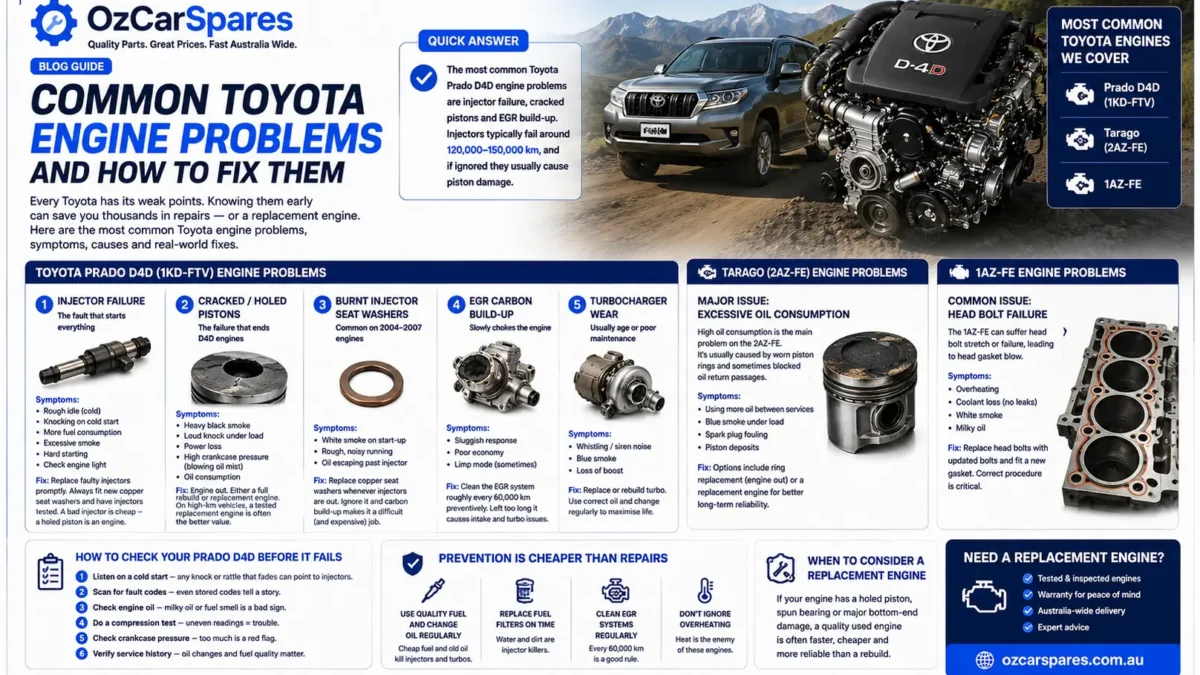
Table of Contents
- Toyota Prado D4D (1KD-FTV) Engine Problems
- 1. Injector failure — the fault that starts everything
- 2. Cracked and holed pistons
- 3. Burnt injector seat washers
- 4. EGR carbon build-up
- 5. Turbocharger wear
- How to Check Your Prado D4D Before It Fails
- Toyota Tarago Engine Problems (2AZ-FE)
- Excessive oil consumption
- Stripped head bolt threads
- Toyota 1AZ-FE Engine Problems
- Which Faults Are Worth Repairing?
- Preventing Toyota Engine Failure
- When Replacement Beats Repair
- What are the most common Toyota Prado D4D engine problems?
- At what kilometres do Prado D4D injectors fail?
- Why do 1KD-FTV pistons crack?
- Why does my Toyota Tarago burn so much oil?
- What causes stripped head bolts on the 2AZ-FE?
- Are Toyota 1AZ-FE engine problems the same as the 2AZ-FE?
- How long should a Prado D4D engine last?
- Is it cheaper to repair or replace a Toyota engine?
Toyota’s reputation is well earned, but a few engines have genuine weak points — and knowing them early is the difference between a manageable repair bill and a replacement engine. The Prado’s 3.0 D4D is the one we get asked about most, usually after someone’s noticed black smoke or a knock that wasn’t there last month.
This guide covers the faults that actually matter on the engines Australians drive: the 1KD-FTV D4D in the Prado and HiLux, the 2AZ-FE in the Tarago, and the 1AZ-FE. For each one you’ll find the warning signs, what causes it, and what fixing it realistically involves.
Quick answer: The most common Toyota Prado D4D engine problems are injector failure, cracked or holed pistons, and EGR carbon build-up. Injectors typically fail around 120,000–150,000 km, and if ignored they’re the usual cause of piston damage. Catching injector faults early is the single best way to avoid a rebuild.
Toyota Prado D4D (1KD-FTV) Engine Problems
The 3.0-litre 1KD-FTV powers the Prado, HiLux and Fortuner, and it’s a genuinely tough engine — many pass 400,000 km. But it has a well-documented failure chain, and understanding it explains almost everything that goes wrong.
1. Injector failure — the fault that starts everything
Injectors are the D4D’s weak point, and they matter far more than most owners realise. They commonly begin failing around 120,000 km, sometimes earlier on poor fuel.
Here’s the part that catches people out: a failing injector doesn’t just run badly. It sprays fuel in the wrong pattern, which concentrates heat on one spot of the piston crown. Left long enough, it burns a hole straight through the piston. Nearly every catastrophic D4D failure we see traces back to injectors that were ignored.
Symptoms to watch for:
- Rough idle, especially when cold
- Knocking or rattling on a cold start
- Fuel consumption creeping up
- Excessive smoke
- Hard starting
- Check engine light
The fix: Replace faulty injectors promptly, and always replace the copper seat washers at the same time. Have them tested rather than guessing — a bad injector is a few hundred dollars, a holed piston is an engine.
2. Cracked and holed pistons
This is the failure that ends D4D engines, and it’s concentrated in specific build years. Engines built roughly 2004–2009 are most affected, particularly the Euro 4 versions from August 2006 onward, where a reinforced zone in the piston crown was dropped from the design. Toyota revised the pistons and added improved oil jets in later production.
Failure typically appears between 100,000 and 150,000 km on affected engines.
Symptoms:
- Heavy black smoke
- Loud knocking under load
- Noticeable power loss
- High crankcase pressure — often blowing oil mist from the breather
- Oil consumption climbing
The fix: There’s no cheap version. A holed piston means the engine comes out. Depending on the damage, it’s either a full rebuild or a replacement engine — and on a high-kilometre vehicle, a tested replacement engine is frequently the better value.
3. Burnt injector seat washers
A specific fault worth knowing, common on 2004–2007 engines. The copper washers under the injectors burn out and lose their seal, letting combustion gases and oil escape.
Symptom: White smoke on start-up, with a rougher, noisier engine. Oil can find its way into places it shouldn’t.
The fix: Straightforward if caught early — replace the washers whenever injectors are out. Ignoring it lets carbon build up around the injector bore, which turns a simple job into a difficult one.
4. EGR carbon build-up
The EGR system recirculates exhaust gas, and over time carbon coats the valve and intake manifold. It’s not usually catastrophic, but it strangles airflow and drags performance down.
Symptoms: Sluggish response, poor economy, sometimes a limp-mode event.
The fix: Clean the EGR system roughly every 60,000 km as preventive maintenance. Left too long, carbon can migrate and cause intake and turbo problems.
5. Turbocharger wear
The CT16V turbo generally lasts well, but at high kilometres bearings and seals wear. Usually a consequence of age or poor oil maintenance rather than a design flaw.
Symptoms: Whistling or siren-like noise, blue smoke, loss of boost.
How to Check Your Prado D4D Before It Fails
If your Prado is approaching 120,000 km, this ten-minute routine can save you an engine.
- Listen on a cold start. A knock or rattle when cold that fades as it warms is a classic early injector symptom. Don’t dismiss it.
- Watch the exhaust. White smoke on start-up suggests injector seat washers. Black smoke under load points to injectors or worse.
- Check the oil breather. Excessive mist or pressure from the breather can indicate cylinder pressure escaping past a damaged piston.
- Track your fuel consumption. A steady climb with no change in driving is often the first measurable sign of injector wear.
- Have injectors tested at 120,000 km. Testing is cheap. It’s the highest-value diagnostic on this engine.
- Get a compression test if anything looks off. Uneven cylinders confirm internal damage before you spend money on parts.
If steps 3 or 6 show problems, stop driving it hard. Continuing to run a D4D with a cracked piston turns a repairable engine into scrap metal.
Toyota Tarago Engine Problems (2AZ-FE)
Australian Taragos from the 2000s onward use the 2.4-litre 2AZ-FE, an engine with two distinct personalities depending on build year. Early ones have a structural weakness; later ones burn oil.
Excessive oil consumption
The headline 2AZ-FE fault. Affected engines can burn a litre every 1,000–1,600 km, which is extraordinary for a Toyota.
The cause is a piston ring design issue. The oil return holes behind the oil control rings are undersized and clog with carbon. Once blocked, the rings seize in their grooves and stop scraping oil off the cylinder walls, so it burns in the combustion chamber. It often starts surprisingly early — sometimes around 70,000–80,000 km.
Symptoms: Oil level dropping between services, blue smoke on start-up or acceleration, fouled spark plugs, low oil warning light.
The fix: Additives and thicker oil are temporary at best — once the rings are carboned up, they don’t recover. The permanent repair is replacing pistons and rings, which is labour-heavy. On a high-kilometre Tarago, compare that quote against a replacement engine before committing.
Stripped head bolt threads
The more serious 2AZ-FE fault, and it mainly affects earlier engines. The aluminium block expands more than the steel bolts when hot, and over repeated heat cycles the threads strip — typically the middle bolts toward the rear of the engine. The head lifts, the gasket fails, and coolant escapes.
Symptoms: Overheating, coolant loss (often from the rear of the engine), white exhaust smoke, milky oil.
The fix — and this matters: Replacing the head gasket alone will fail again quickly. The block threads must be repaired with steel thread inserts. If a workshop quotes a gasket without mentioning thread repair, get another opinion.
The connection between the two faults: Oil consumption causes low oil, low oil causes overheating, and overheating is what strips the threads. Staying on top of oil levels genuinely prevents the bigger failure.
Toyota 1AZ-FE Engine Problems
The 2.0-litre 1AZ-FE shares much of its design with the 2AZ-FE, and unsurprisingly it shares the problems:
- Oil consumption from the same piston ring and oil return hole design
- Head bolt thread stripping in the aluminium block, same cause and same fix
- Timing chain wear at higher kilometres — listen for rattle on start-up
- VVT and oil control valve issues, often showing as rough running or a fault code
The approach is identical: monitor oil levels closely, never let it overheat, and if the head gasket goes, insist on proper thread repair.
Which Faults Are Worth Repairing?
A rough guide from what we see day to day:
| Fault | Severity | Usually worth repairing? |
|---|---|---|
| D4D injectors | Moderate | Yes — always, and quickly |
| D4D injector seat washers | Minor | Yes, easy fix if early |
| D4D EGR carbon | Minor | Yes, routine maintenance |
| D4D cracked piston | Severe | Compare rebuild vs replacement engine |
| D4D turbo wear | Moderate | Usually yes |
| 2AZ oil consumption | Moderate | Depends on km and labour cost |
| 2AZ stripped head bolts | Severe | Only with proper thread inserts |
| 1AZ timing chain | Moderate | Yes if the engine is otherwise sound |
The general rule: if the repair quote approaches half the value of a tested replacement engine, get both prices before deciding.
Preventing Toyota Engine Failure
Most of the failures above are preventable, and the pattern is consistent:
- Check oil monthly, not just at services. This alone prevents the worst 2AZ-FE outcomes.
- Use the correct oil grade. Wrong viscosity accelerates ring and bearing wear.
- Never ignore a cold-start knock. On a D4D it’s the earliest warning you’ll get.
- Test injectors at 120,000 km on any 1KD-FTV.
- Clean the EGR every 60,000 km on diesels.
- Fix overheating immediately. Heat causes the aluminium-block failures.
- Use quality diesel — common-rail injectors are sensitive to fuel quality.
The engines that reach 400,000 km aren’t lucky. They belong to owners who acted on small symptoms early.
When Replacement Beats Repair
Sometimes the maths is clear. Consider a replacement engine when:
- A piston has cracked or holed on a high-kilometre D4D
- Head bolt threads have stripped and the block is damaged beyond insert repair
- Oil consumption repair costs approach engine replacement
- Multiple major faults appear at once
- The engine has an unknown or poor service history
If you’re at that point, send us your VIN and we’ll confirm which engines suit your vehicle and what’s available, along with warranty terms in writing.
What are the most common Toyota Prado D4D engine problems?
Injector failure, cracked or holed pistons, burnt injector seat washers, EGR carbon build-up and turbocharger wear. Injectors are the most common and the most important, since failing injectors are the usual cause of piston damage.
At what kilometres do Prado D4D injectors fail?
Typically around 120,000–150,000 km, though poor fuel quality can bring it forward. Having them tested at 120,000 km is the cheapest insurance available on this engine.
Why do 1KD-FTV pistons crack?
Engines built between roughly 2004 and 2009 are most affected, particularly Euro 4 versions where a reinforced zone in the piston crown was removed. A failing injector concentrates heat on the piston crown, and over time that burns through it. Toyota revised the pistons and oil jets in later production.
Why does my Toyota Tarago burn so much oil?
The 2AZ-FE has undersized oil return holes behind the oil control rings. They clog with carbon, the rings seize, and oil passes into the combustion chamber. Some engines burn a litre every 1,000–1,600 km. The permanent fix is replacing pistons and rings.
What causes stripped head bolts on the 2AZ-FE?
The aluminium block expands more than the steel head bolts when hot, and repeated overheating strips the threads — usually the middle bolts near the rear. Repair requires steel thread inserts; replacing the head gasket alone will fail again.
Are Toyota 1AZ-FE engine problems the same as the 2AZ-FE?
Largely yes. The 1AZ-FE shares the oil consumption and head bolt thread issues, and can also develop timing chain wear and VVT faults at higher kilometres.
How long should a Prado D4D engine last?
With disciplined maintenance — injector testing, EGR cleaning and regular oil changes — 400,000 km is achievable. Neglected examples with untreated injector faults can fail well before 200,000 km.
Is it cheaper to repair or replace a Toyota engine?
It depends on the fault. Injectors, EGR cleaning and washers are always worth repairing. Once a piston has cracked or a block is damaged, a tested replacement engine is often cheaper than a rebuild and comes with a warranty. Get both quotes before deciding.

Looking for this part?
Send one enquiry and reach Australian suppliers who handle your vehicle.
Request a quote